Aller au contenu

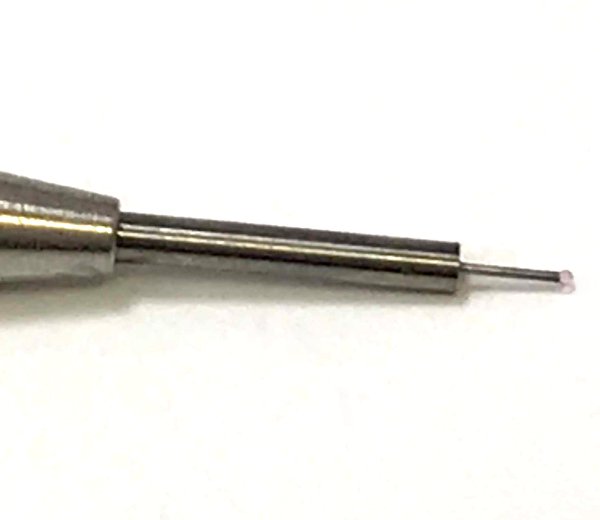
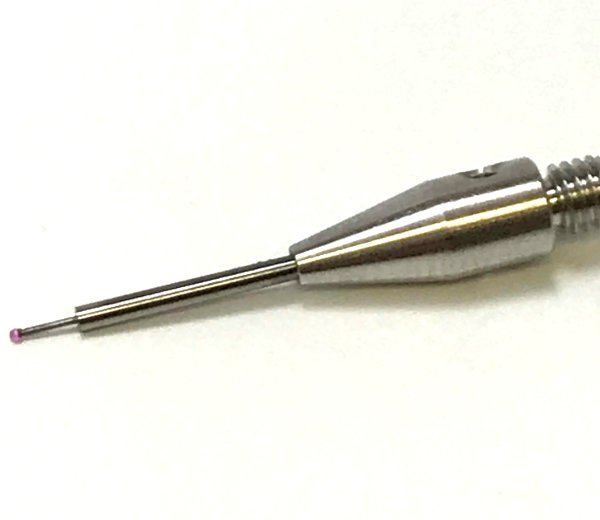
Indenteur sphérique (D=0.2 mm)

MA032

Un indenteur sphérique (Bille de rubis, D=0.2 mm)

UGS : MA032 Catégories: ,

(En anglais seulement) The smaller the indenter diameter, the more the mechanical characterization data will come from the surface of the sample. It is very important to adjust the size of the indenter with the critical size of the sample. Each indenter is made of a highly smooth and spherical ruby ball mounted on a carbide stem and stainless steel base. Manipulation of the very small indenters should be done with great care since those assemblies are relatively fragile. The Holder for Spherical Indenters (MA031) is required. Images shown are those of the D=0.3mm spherical indenter.

  • Cet accessoire a été conçu pour faciliter son nettoyage et sa désinfection.
  • Compatible avec une utilisation en solution physiologique saline.
  • Facile à assembler et à monter sur le testeur
  • La bille rouge en rubis facilite le positionnement de l’indentateur lorsque l’échantillon est dans un bain de solution.
Matériaux

Tige de carbure et bille de rubis

Diamètre

0.2 mm

Fixation du haut

M3 Male Thread

Documents et ressources (1)

Configurations de test (5)

FAQ

Comment fonctionne le modèle élastique en indentation "Elastic Model in Indentation"?

(En anglais seulement) This tool allows for the computing and visualizing of the shear modulus (MPa) and the Young’s modulus (MPa) from an indentation test performed using a spherical indenter (Figure 1). This model is well adapted for the mechanical characterization of samples (with critical diameter (width) at least 5 times the indenter diameter) bonded on a flat rigid support (at least 10 times stiffer than the sample), for example: any sheet of material lying on a rigid chamber base (limited sliding at the interface can be assumed) or a cartilage layer attached to a thick sub-chondral bone. A user license is required to obtain the results of the elastic model in indentation (Software Add-On, contact Biomomentum to obtain your license).


Results analysis is performed considering the indentation mechanics of an infinitely wide elastic layer bonded to a rigid half-space which has been developed as a model for the layered geometry of cartilage and subchondral bone (Hayes et al., 1972). (Figure 2) shows a schematic representing the modeled situation.

Many parameters need to be specified in order to calculate the different material properties.

1. Indenter Shape is:

  • Spherical
  • Plane-Ended Cylindrical

2. Indenter radius in mm.

3. Poisson ratio can be selected from a drop-down list (Figure 3)


4. Position @ contact is – defines the position of the left cursor:

  • to be curvefit – will automatically find the position contact which will give the smallest mean squared error (mse)
  • the value at t0 – will automatically take the position contact at the start of the curve
  • the following value (mm) – the user need to specify the value in the corresponding field next to the drop-down list
  • cursor position – the user can drag the left cursor to the wanted position contact

5. Sample thickness is the:

  • position @ contact – will automatically find the position at contact (position of the left cursor)
  • following value (mm) – the user need to specify the value in the corresponding field next to the drop-down list

6. Curvefit is up to – defines the position of the right cursor:

  • peak load – will automatically take the position of the peak load
  • delta load (unit) – the user need to specify the value of the desired delta load in the corresponding field next to the drop-down list
  • delta position (mm) – the user need to specify the value of the desired delta position in the corresponding field next to the drop-down list

The error on the estimation of the best curve representing the stress relaxation curve is calculated using the root of the mean squares (RMS) method and is displayed under “mse”. For example, (Figure 4) shows parameters used for the “Normal Indentation” (Mach-1 Motion) function in an indentation testing protocol on ovine articular surfaces. Corresponding results are shown in (Figure 1).

Spherical Indentation Guide – Mach-1 Mechanical Tester – Biomomentum

Mach-1 Analysis – Modèle élastique en Indentation – Paramètres

Mach-1 Analysis – Modèle élastique en indentation – Poisson ratio choix

Mach-1 Analysis-Modèle élastique dans l’indentation–Cartilage & os sous-chondral

Mach-1 Analysis – Modèle élastique en Indentation – Exemple

Quelles sont les caractéristiques de la fonction d'indentation normale "Normal Indentation"?
Cette fonction détecte précisément la hauteur et l'orientation de la surface de l'échantillon en position XY et enregistre la charge (pour cellules de charge multiaxiale uniquement) tout en déplaçant simultanément les trois acuateurs linéaires à des vitesses différentes afin de déplacer un indentateur sphérique avec un profil de déplacement prédéfini le long d'un axe virtuel normal (perpendiculaire) à la surface de l'échantillon.

Paramètres:
CRITÈRES DE CONTACT Z - L'utilisateur spécifie la charge à atteindre jusqu'à ce que l'acuateur cesse de bouger. Le logiciel analyse la courbe de charge "load-displacement" et ramène l'acuateur à la position où la charge avait commencé à augmenter (soit, le double de la résolution de la cellule de charge) (vous pouvez aussi vous référez à la description de la fonction Find Contact).
GRILLE DE SCANNAGE - Précisez la distance "d" à partir de l'emplacement du test et des 4 points de contrôle situés à proximité du lieu de test (xi, yi) = (-d, 0), (d, 0), (0, -d ) Et (0, d).
AMPLITUDE D'INDENTATION - Il s'agit de l'amplitude de l'indentation normale. La variation de force complète de l'acuateur est permise. Une amplitude positive entraînera l'indentateur vers l'échantillon (compression).
VITESSE D'INDENTATION - Il s'agit de la vitesse de l'indentation normale. Vous pouvez vous référer aux spécifications de votre modèle Mach-1™ pour connaître la variation de vitesse à laquelle l'indentation normale peut être faite. Dans le logiciel Mach-1 Motion, la vitesse est toujours spécifiée en termes de valeur absolue.
TEMPS DE RELAXATION - C'est la période durant laquelle la position est maintenue à l'amplitude commandée (période de relaxation).

Spherical Indentation Guide – Mach-1 Mechanical Tester – Biomomentum

Mach-1 Motion – Fenêtre de la fonction Normal Indentation

Besoin d’aide pour choisir un accessoire ?

Parlez à notre équipe

Report a problem with this page

Your email is used only to follow up on this report.

Screenshots (optional)

Click this area and paste a screenshot, or drag files here. Up to 3 PNG, JPEG or WebP images; 5 MB per image. Hide confidential information first.

Please do not include passwords or customer information. Reports and screenshots are private.