Johannes Pordzik; Anke Bernstein; Hermann O. Mayr; Sergio H. Latorre; Anastasija Maks; Hagen Schmal; Michael Seidenstuecker
December 2020Applied Sciences 10(24):9012
https://doi.org/10.3390/app10249012
9 citations · 4 en 2025–2026
Les titres, résumés et légendes des publications sont présentés en anglais.
Abstract: Studies on osteoarthritis of the knee have examined isolated aspects of the meniscus biomechanically and histologically, but not the difference between instantaneous modulus (IM) in healthy and diseased samples. The aim of this study is to investigate the difference in the biomechanical behavior and proteoglycan content between arthritic and arthritis-free menisci. In addition, the relationship between the biomechanical behavior and proteoglycan content should be investigated. A novel indentation-based method was used, which allows the mapping of the entire meniscus, without damaging it for histological examinations. A total of 26 arthritic and 14 arthritis-free samples were examined in the present study. A Mach-1 Model V500css test machine was used for biomechanical testing. A position grid was placed over each sample allowing all measurements (indentation test and thickness measurements) to be taken at the same position. All sections were then graded for Safranin O staining intensity for proteoglycan content. The maximum applied load of our arthritic samples above the posterior horn was statistically significantly higher (p = 0.01) at 0.02 ± 0.02 N than the maximum applied load of the arthritis-free samples at 0.01 ± 0.01 N. The proteoglycan content of the meniscus, evaluated by the Safranin O score, correlated statistically significantly with the maximum applied load over the entire meniscus (p = 0.04, 95% CI: 0.06–0.71). The present study showed that in the final stage of gonarthritis, the attenuation behavior of the meniscus was significantly lower compared to the arthritis-free knee. The mapping of IM and histological examination of the meniscus showed a direct correlation between changes in proteoglycan content and altered mechanical properties of the meniscus in gonarthritis.
Utilisation des équipements
Le Mach-1 mesurait la réponse par indentation et l’épaisseur de ménisques arthrosiques et non arthrosiques.
Figures

Figure 1 — Show caption
Mach-1 thickness measurement via the needle method (A,B); measuring positions on the meniscus (C).
Johannes Pordzik, Anke Bernstein, Hermann O. Mayr, Sergio H. Latorre, Anastasija Maks, Hagen Schmal and Michael Seidenstuecker — Figure 1

Figure 2 — Show caption
Mapping of instantaneous modulus (IM) in arthritis-free samples (A) and arthritic meniscus (B).
Johannes Pordzik, Anke Bernstein, Hermann O. Mayr, Sergio H. Latorre, Anastasija Maks, Hagen Schmal and Michael Seidenstuecker — Figure 4

Figure 3 — Show caption
Comparison of the IM in MPa (A) arthritic: 0.17 ± 0.1 MPa; arthritis-free: 0.12 ± 0.07 MPa (p = 0.06) and maximum applied load (B) arthritic: 0.02 ± 0.02 N; arthritis-free: 0.01 ± 0.01 N over the posterior horn of the meniscus between menisci (p = 0.01), taken in total knee replacements (TKR) due to osteoarthritis and menisci, taken from donors without osteoarthritis as a control group: * = statistically significant difference with p < 0.05; error bar with +/−1 SD.
Johannes Pordzik, Anke Bernstein, Hermann O. Mayr, Sergio H. Latorre, Anastasija Maks, Hagen Schmal and Michael Seidenstuecker — Figure 5
Matériaux (1)
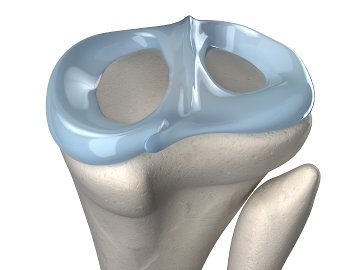
Ménisque
Configurations de test (3)

Cartographie 3D en indentation normale

Indentation (Raideur)
