Alejandro Peña-Trabalon; Maria Prado-Novoa; Luisa de Roy; Andreas M. Seitz; Salvador Moreno-Vegas; M. Belen Estebanez Campos; Ana Perez-Blanca
XVI Congreso Iberoamericano de Ingeniería Mecánica, Concepción, Chile, 22–24 October 2024. Full conference paper, 11 pages. English title is an identified translation of the original Spanish title. Original English abstract. Alternate-title deposit: https://hdl.handle.net/10630/40185. Related journal article in 2025 is a distinct publication.
Les titres, résumés et légendes des publications sont présentés en anglais.
This work deals with the study of the influence of circumferential traction on sutured meniscal horns subjected to indentation tests, as well as the suitability of using material properties obtained from isolated compression tests versus those from combined load tests in finite element (FE) models subjected to combined loading. Non-destructive indentation tests were performed on 27 sutured human meniscal horns at three circumferential load levels: 0N, 10N and 20N. Eighty-four FE models were developed from one specimen with the same experimental setup and with experimentally obtained material properties at the different tensile states. Circumferential tension generated significant differences between the maximum force at indentation and the instantaneous modulus with respect to the state without circumferential loading. Simulations under combined loading provided more accurate results when using material properties obtained from tests under the same stress state.
Utilisation des équipements
Un Mach-1 v500css réalisait l’indentation sphérique et la relaxation sur 27 cornes méniscales humaines suturées, avec un indenteur de 2 mm de diamètre, une profondeur de 0,5 mm et un maintien de 20 s. Un support incliné alignait la surface. Un dispositif manuel séparé appliquait les charges circonférentielles de 0, 10 et 20 N.
Article et documents
Consulter la source
Matériaux (1)
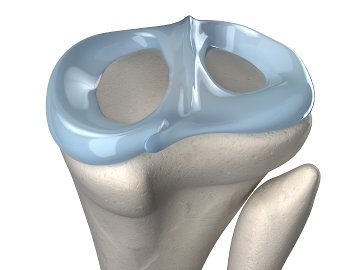
Ménisque
Configurations de test (2)
