Alejandro Peña-Trabalon; Maria Prado-Novoa; Luisa de Roy; Andreas M. Seitz; Salvador Moreno-Vegas; M. Belen Estebanez Campos; Ana Perez-Blanca
Acta Mech., Volume 42, article number 624717, Published: 04 June 2025
https://doi.org/10.1007/s10409-025-24717-x
0 citations · 0 en 2025–2026
Les titres, résumés et légendes des publications sont présentés en anglais.
Abstract
Currently, knee models often use meniscal horn material models based on pure compression indentation tests. The tissue has circumferential fibrils to withstand traction from the meniscal roots, besides tibiofemoral compression. This study explores whether incorporating fiber-directional traction in indentations improves meniscal horn modeling. To our knowledge, this is the first such analysis on fibril-reinforced biological tissue. Twenty-seven sutured human meniscal horns (65 ± 6 years old; 17 female, 10 male) were indented at 7 points each and subjected to 3 traction levels: unloaded, 10 and 20 N. Eighty-four FE models of one specimen simulated the 7 indentations under the 3 tensile levels, applying 4 different material models strategies derived from indentation outcomes of specific specimen unloaded, specific specimen at maximum traction, mean of 27 specimens unloaded and mean of 27 specimens at maximum traction. Indentations showed increases for both traction levels from the unloaded state in maximum force (p = 0.02 for 10 N; p = 0.007 for 20 N), instantaneous modulus (p = 0.002 for 10 N; p < 0.001 for 20 N) and relaxation modulus (p < 0.001 for 10 and 20 N). No differences were found between the loaded levels. FE models using properties from indentation tests under traction conditions similar to the simulated one provided more accurate predictions, being more precise when using specimen-specific data. Therefore, indentation outcomes of sutured meniscal horns are affected by fiber-directional traction. Simulations of combined stress states with axial compression and circumferential traction, over the toe-zone of the fiber-direction traction load-deformation curve, as occurs physiologically, are more accurate using material properties from traction-included rather than pure compression indentation tests.
Utilisation des équipements
L’étude examine l’indentation de cornes méniscales humaines suturées sous traction dans la direction des fibres afin de déterminer des propriétés compressives pour la modélisation numérique. Le résumé disponible décrit la force d’indentation et les modules instantané et de relaxation, mais n’identifie pas l’instrument d’essai ni le rôle d’un Mach-1 Mechanical Tester.
Matériaux (1)
Matériau
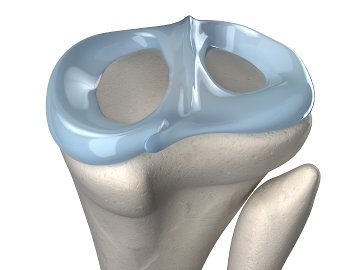
Ménisque
Configurations de test (3)

Configuration de test
Cartographie 3D en indentation normale

Configuration de test
Indentation (Raideur)

Configuration de test