Hamed Helisaz
UBC Theses and Dissertations , Applied Science, Faculty of Mechanical Engineering, University of British Columbia, Published: September 2022.
https://doi.org/10.14288/1.0420751
Les titres, résumés et légendes des publications sont présentés en anglais.
Abstract
Mechanical properties of biological tissues have been shown to vary in the presence of pathological disorders. This dissertation aims to investigate the effect of cancer on the viscoelastic properties of prostate gland. We use the quasi-linear viscoelastic model to characterize the elastic and viscous characteristics of thirty-five fresh prostate glands, removed within two hours of radical prostatectomy surgery. The viscoelastic properties of normal and cancerous prostates are compared to reveal the influence of cancer grade and tumor volume on the elasticity and viscosity of prostate tissue. We first present a novel method for describing the time-dependent behavior of soft materials using one-dimensional quasi-linear viscoelastic model. Our model derives the elastic (Young’s modulus) and viscous (shear relaxation modulus) properties by analyzing the stress response after a sudden uniaxial compression. The model is validated using experimental data on the phantoms that mimic the elasticity of normal and cancerous prostate tissues. The applicability of the model for material characterization is demonstrated by introducing a procedure for obtaining the mechanical properties via indentation test. Using three-dimensional equations and pre-calculated finite element analysis, the procedure introduces a fast and straightforward approach that is superior to inverse finite element methods. We evaluate our procedure by comparing the derived properties with those obtained from uniaxial compression test, where the results show high precision (standard deviation less than 10%) and good accuracy (error less than 20%).
Finally, the procedure introduced for material characterization is used to characterize the viscoelastic properties of prostate gland. We test four different locations on fresh, unfixed prostate samples and compare the properties of locations where cancer spreads with those where cancer is not present. Our data-driven results demonstrate that tumor volume increases elastic and viscous properties of prostate with high statistical significance (p-value < 2%), which reflects the potential of using the mechanical properties of prostate as a cancer biomarker. However, the author admits the challenges for realizing an in vivo apparatus to measure the viscoelastic properties of prostate. In fact, in vivo application of the findings requires other considerations that are not discussed here.
Method Validation and Confidence Interval
We compare the relaxation behavior for one of the tissue-mimicking phantoms (Elastomer III) with that predicted by the QLV model. The phantom is subject to four different compression strains, i.e. ε = 30%,40%,50% and 60%. The QLV parameters are obtained by fitting the theory to the experimental results for 50% compression strain. We then use the same parameters for describing the behavior of the same material under 30%, 40%, and 60% strain levels and compare our prediction with the experimental results. The experiments were performed by the mechanical tester Mach-1 V500CS (Biomomentum Inc., Laval, QC, Canada). The tester has the multiple-axis load cell MA234 (Biomomentum Inc.) with a range of 35 N, a resolution of 1.75 mN, and a recording rate of 100 Hz. The load cell is connected to the phantom by a compression plate with a diameter of 25 mm. The compression plate has slightly larger size than the samples to guarantee a uniaxial stress state.
Utilisation des équipements
Le Mach-1 mesurait la compression d’échantillons de fantômes pour valider un modèle viscoélastique quasi linéaire.
Article et documents
Document
Consulter l’article
Matériaux (1)
Matériau
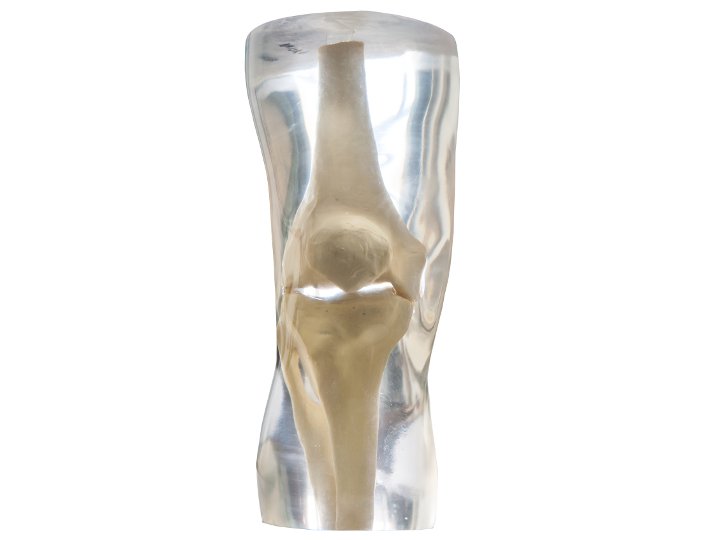
Tissus mous (fantôme)
Configurations de test (2)

Configuration de test
Compression Non-Confinée

Configuration de test