Tissus mous (fantôme)
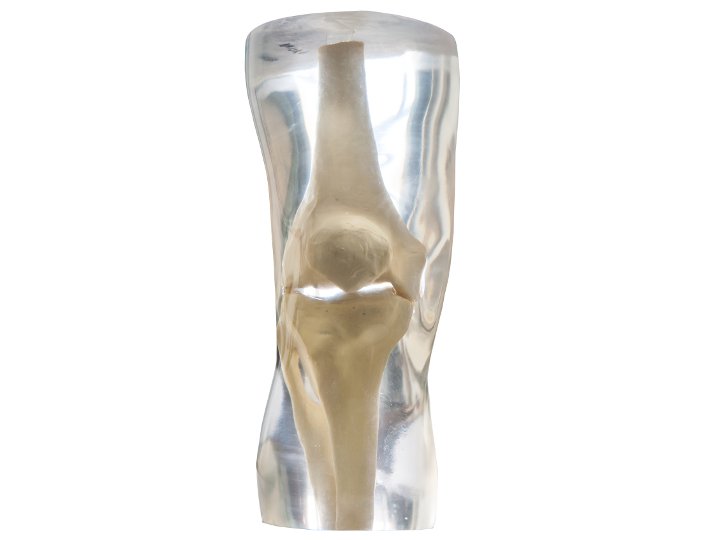
Phantoms of soft tissues are easier to handle and eliminate the problem of sample-specific differences.
À propos de ce matériau
(En anglais seulement) Phantoms of soft tissues are easier to handle and eliminate the problem of sample-specific differences. They are widely used in surgical training from imaging technique (MRI, X-Ray, uCT, etc.) to the modelling of interactions between devices and soft tissue. Mechanical assessment of phantom materials is essential since they need to closely mimic the properties of soft tissues with the goal of transposing the findings to medical procedures.
Configurations de test (16)
Tension
Compression Non-Confinée
Indentation (Raideur)
Friction
Cartographie 3D d'épaisseur
Torsion
Cisaillement
Compression confinée

Contrôle de la temperature
Positionnement (manuel angulaire)
Perforation
Capteurs analogues externes
Flux de caméra
Positionnement (manuel)
Positionnement (X Auto)
Études de cas (2)
Ressources associées (3)
Littérature associée
From Geometry to Function: Programmable Mechanical Response in 3D-Printed Adipose-Inspired Soft Metamaterials
Alice Berardo; Gianmarco Dolino; Damiano Coato; Paolo Gargiulo; Emanuele Luigi Carniel
Advanced Functional Materials (2026): e77047, published: 02 August 2026
2 citations · 2 en 2025–2026
Mechanical characterisation of lymph nodes and optimisation of needle-tissue interaction for endobronchial biopsy
University of Glasgow. PhD thesis. 2026.
0 citations · 0 en 2025–2026
Redesign and Flow Characterization of Microcapsules through Hollow 3D-Printed Microneedles
Master of Science thesis, Bioengineering, Santa Clara University, June 2026.
An in silico approach to the mechanical design of meta-materials for adipose tissue engineering
Emanuele Luigi Carniel; Chiara Giulia Fontanella; Maria Vittoria Mascolini; Sofia Pettenuzzo; Ilaria Toniolo; Alice Berardo
Research article, Volume 11, Issue 10e43430, Published: May 2025
2 citations · 2 en 2025–2026
Prototypical fabrication of phantoms for experimental testing of the mechanical interaction processes between artificial sphincters and the urethra [English translation]
Università degli Studi di Padova, Laurea in Ingegneria Biomedica, 24 September 2024, cover verified. English title is the author-provided translated title in the official repository; Italian original title retained in provenance. Original Italian abstract copied in full, language explicitly recorded. Chapter 7, PDF pp.60–63, documents Mach-1 material tests; Figure 7.6 shows a free-sided silicone block between plates. Chapter 8 uses a separate sphincter-flow bench, not Mach-1. No native urethra or donor species assigned.
Accounting for the Viscoelastic Properties of Breast Tissue in Optical Coherence Elastography
Percy Smith; Luis Chavez; Xavier Intes; David T. Corr
2024 BMES Annual Meeting. Cancer Technologies, Poster S13. 24 October 2024.
Fibre Optic Interrogated Palpation Sensor for Mechanical Tissue Assessment in Minimally Invasive Surgery
Mark W. McDonald; Ciara B. Durcan; Mahmood A. Saleh; Robert L. Reuben; Duncan P. Hand; Yuhang Chen; William N. MacPherson
IEEE Xplore, ISBN:979-8-3503-6352-4, Published: 17 December 2024
1 citation · 1 en 2025–2026
HyperU-Mesh: Real-time deformation of soft-tissues across variable patient-specific parameters
Sidaty El Hadramy; Nicolas Padoy; Stéphane Cotin
Computational Biomechanics Workshop at MICCAI 2024, Oct 2024, Marrakech, Morocco., Submitted on 17 Jul 2024
2 citations · 2 en 2025–2026
Microneedles for Wound Healing
Maya Matheny; Maggie Dubus; Lily Eribes
Santa Clara University, Bioengineering Senior Thesis, June2023. Repository: https://scholarcommons.scu.edu/bioe_senior/125/
Effect of continuous local dexamethasone on tissue biomechanics and histology after inhalational burn in a preclinical model
Ronit Malka; Gabriela Gonzales; Will Detar; Lisa Marinelli; Christine M. Lee; Alisa Isaac; Solaleh Miar; Stacy Cook; Teja Guda; Gregory R. Dion
Laryngoscope Investigative Otolaryngology. 2023;1–7, Accepted: 26 May 2023
8 citations · 3 en 2025–2026
Mechanical Characterisation of Soft Materials for EBUS-TBNA
L. R. Mkoh; S. Bicknell; R. Sayer; S. Cochran; E. Henderson
British Society for Strain Measurement, 2023 Glasgow conference, Soft Materials & Associated Devices.
Quantifying the Impact of Cancer on the Viscoelastic Properties of the Prostate Gland using a Quasi-Linear Viscoelastic Model
Hamed Helisaz; Eric Belanger; Peter Black; Mattia Bacca; Mu Chiao
Acta Biomaterialia, 2023, ISSN 1742-7061, Published: 7 November 2023
11 citations · 7 en 2025–2026
An investigation of cancer effect on viscoelastic properties of prostate gland via quasi-linear viscoelastic model
UBC Theses and Dissertations , Applied Science, Faculty of Mechanical Engineering, University of British Columbia, Published: September 2022.
Development of a Biaxial Testing System for Research of Soft Tissue Biomechanics using Laboratory Models
CUNY City College, Thesis, May 2021
Development of Anthropomorphic Fetal MRI Phantom
Ryerson University. MASc thesis, 2021. Original cover and repository Year field: 2021; Scholar export: 2023. Silicone phantom materials were tested; no human tissue was mechanically tested. Original abstract: English.
0 citations · 0 en 2025–2026
Fluid-solid interaction in the rate-dependent failure of brain tissue and biomimicking gels
M. Terzano; A. Spagnoli; D. Dini; A. E. Forte
Preprint submitted to Journal of the Mechanical Behavior of Biomedical Materials February 23, 2021 https://arxiv.org/pdf/2102.11268.pdf
20 citations · 6 en 2025–2026
Quasi-linear Viscoelastic Characterization of Soft Tissue-mimicking Materials
Hamed Helisaz; Mattia Bacca; Mu Chiao
ASME. J Biomech Eng. February 4, 2021 doi: https://doi.org/10.1115/1.4050036
14 citations · 3 en 2025–2026
Anthropomorphic and biomechanical mockup for abdominal aortic aneurysm
Zinan He; Rosaire Mongrain; Simon Lessard; Boris Chayer; Guy Cloutier; Gilles Soulez
Medical Engineering and Physics 77 (2020), 60–68. Original publisher PDF hosted by the author laboratory (LBUM, CRCHUM). Electronic publication date 15 January 2020 confirmed by PubMed 31954613. Original abstract: English. Human detail applies to the surgical AAA tissue, not the synthetic hydrogel or silicone. Tensile tests were performed using a Bose Enduratec ELF 3200, not Mach-1.
4 citations · 2 en 2025–2026
A novel palpation–based method for tumor nodule quantification in soft tissue—computational framework and experimental validation
Javier Palacio-Torralba; Robert L. Reuben; Yuhang Chen
Medical & Biological Engineering & Computing. 2020;58(6):1369–1381. https://doi.org/10.1007/s11517-020-02168-y
18 citations · 2 en 2025–2026
A study of saliva lubrication using a compliant oral mimic
G. Carpenter; S. Bozorgi; S. Vladescu; A.E. Forte; C. Myant; R.V. Potineni; T. Reddyhoff; S.K. Baier
Food Hydrocolloids, Elsevier, Available online 23 January 2019, https://doi.org/10.1016/j.foodhyd.2019.01.049
69 citations · 19 en 2025–2026
Composite hydrogel: A high fidelity soft tissue mimic for surgery
Zhengchu Tan; Daniele Dini; Ferdinando Rodriguez y Baena; Antonio Elia Forte
Materials & Design, 160, 886–894. https://doi.org/10.1016/j.matdes.2018.10.018
65 citations · 13 en 2025–2026
Models and tissue mimics for brain shift simulations
Antonio E. Forte; Stefano Galvan; Daniele Dini
Biomech Model Mechanobiol (2018) 17: 249. https://doi.org/10.1007/s10237-017-0958-7
35 citations · 4 en 2025–2026
Quantitative mechanical assessment of the whole prostate gland ex vivo using dynamic instrumented palpation
Steven J Hammer; Daniel W Good; Paul Scanlan; Javier Palacio-Torralba; Simon Phipps; Grant D Stewart; Will Shu; Yuhang Chen; S Alan McNeill; Robert L Reuben
Proceedings of the Institution of Mechanical Engineers, Part H: Journal of Engineering in Medicine. 2017.
8 citations · 0 en 2025–2026
A composite hydrogel for brain tissue phantoms
Antonio E. Forte; Stefano Galvan; Francesco Manieri; Ferdinando Rodriguez y Baena; Daniele Dini
Materials & Design, 112, 227-238 (2016)
117 citations · 17 en 2025–2026
Soft Tissue Phantoms for Realistic Needle Insertion - A Comparative Study
Alexander Leibinger; Antonio E. Forte; Zhengchu Tan; Matthew J. Oldfield; Frank Beyrau; Daniele Dini; Ferdinando Rodriguez y Baena
Annals of Biomedical Engineering. pp 1-11 (2015)
82 citations · 12 en 2025–2026
FAQ
Qu'est-ce que le module d'Young E?+
Module de laboratoire — Compression non confinée de disques d’hydrogel
Comment fonctionne le modèle "Sinusoid"? +
(En anglais seulement) This feature is used to obtain the Frequency, Amplitude and Offset of a sinusoidal signal. A blue line displays the theoretical sinusoid with the Frequency, Amplitude and Offset obtained (Figure 1). The values of the Frequency, Amplitude and Offset are indicated in the "Results" field. The units vary according to the graph’s axes.
This feature can also be used for sinusoidal stimulus-response analysis. Sinusoidal stimulus shall be selected on the x-axis and the sinusoidal response on the y-axis. The Modulus is the ratio of the response Amplitude over the stimulus Amplitude. The Phase is the phase difference between the response and the stimulus. The Modulus’ is computed as the Modulus*Cos(Phase) and the Modulus” is computed as the Modulus*Sin(Phase). A blue line displays the theoretical sinusoidal stimulus-response with the Frequency, Modulus and Phase obtained (Figure 2). The values of the Modulus and Phase are indicated in the “Results” field. The units vary according to the graph’s axes.
One use for this feature would be to compute material properties by multiplying the Modulus obtained by the appropriate geometric factors. For example, the Young’s Modulus can be obtained during uniaxial compression or tension on cylindrical sample with t/pi*r2 as the geometric factor, t is the thickness and r is the radius of the sample.
Mach-1 Analysis – Sinusoid – Exemple d’analyse stimulus-réponse