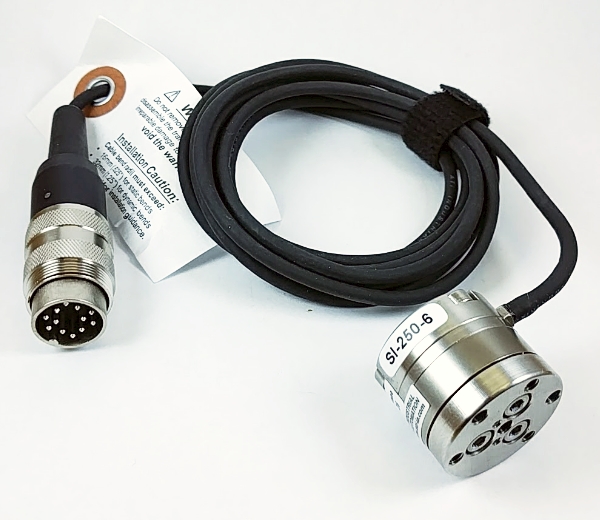
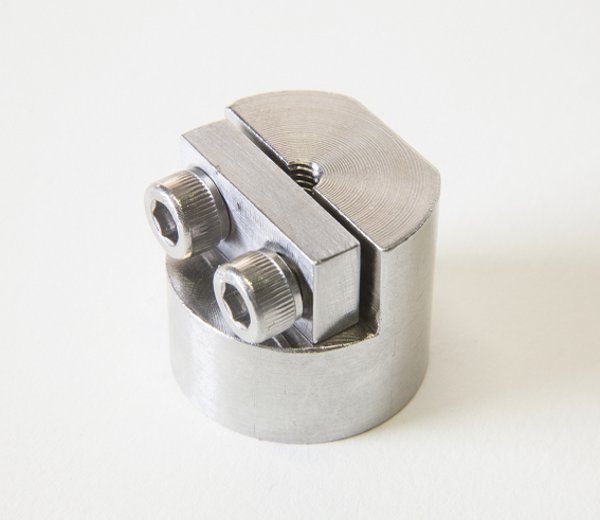
(En anglais seulement) Shear tests can be used to evaluate the shear modulus G of a material in planar shear or in torsion. The shear modulus represents the stiffness of a material when a force is applied in a direction parallel to its movement while its base is kept still. The equilibrium shear modulus G is described as the shear stress over the shear strain. Two configurations are often used to determine the shear modulus: planar shear, which follows a horizontal axis (x or y axis), and torsional shear, which follows a rotational axis. Under the configuration of planar shear, the sample is assumed to be a perfect rectangular prism with one surface under stress and its opposite surface constrained. Under the configuration of torsional shear, the sample is assumed to be a perfect cylinder (moment of inertia correction can be applied for other shapes) with its top and bottom surfaces perfectly attached to both platens (non-slipping boundary condition).
Testeur recommandé (1)

Accessoires (7)
Études de cas (1)
Ressources associées (3)
Littérature associée
Tissue-Engineered Osteochondral Allograft Versus Fresh Osteochondral Allograft: Comparable Cartilage and Subchondral Bone Repair in a 14-Month Equine Osteochondral Defect Model
Laura E. Keller; Terri-Ann N. Kelly; Jacqueline M. Chevalier; Hyung Jin Jung; Garett B. Pearson; Laila Begum; Olivia S. Beane; Sarindr Bhumiratana; Lisa A. Fortier
The American Journal of Sports Medicine. 2026;54(3):622-634, published: February 10, 2026
1 citation · 1 en 2025–2026
Mechanical insights into fat pads: a comparative study of infrapatellar and suprapatellar fat pads in osteoarthritis
Sofia Pettenuzzo; Alice Berardo; Elisa Belluzzi; Assunta Pozzuoli; Pietro Ruggieri; Emanuele Luigi Carniel; Chiara Giulia Fontanella
Connective Tissue Research, 1–12, Published: 09 May 2025
34 citations · 34 en 2025–2026
Liquid-bodied antibiofilm robot with switchable viscoelastic response for biofilm eradication on complex surface topographies
Bonan Sun; Junjia Guo; Bo Hao; Yanfei Cao; Tony K. F. Chan; Mengmeng Sun; Joseph J. Y. Sung; Li Zhang
Science Advances. 2025;11(11):eadt8213.
28 citations · 28 en 2025–2026
Mechanics and microstructure of blood plasma clots in shear driven rupture†
Ranjini K. Ramanujam; Konstantinos Garyfallogiannis; Rustem I. Litvinov; John L. Bassani; John W. Weisel; Prashant K. Purohit; Valerie Tutwiler
Soft Matter. 2024;20(21):4184-4196.
16 citations · 14 en 2025–2026
A novel workflow to fabricate a patient-specific 3D printed accommodative foot orthosis with personalized latticed metamaterial
Yuri F Hudak; Jing-Sheng Li; Scott Cullum; Brian M Strzelecki; Chris Richburg; G Eli Kaufman; Daniel Abrahamson; Jeffrey T. Heckman; Beth Ripley; Scott Telfer; William R Ledoux; Brittney C Muir; Patrick M Aubin
Medical Engineering & Physics, Volume 104, 2022, 103802, ISSN 1350-4533, https://doi.org/10.1016/j.medengphy.2022.103802.
53 citations · 33 en 2025–2026
Biomechanical analysis of Osteoarthritic Infrapatellar Fat Pad (IFP) and Suprapatellar Fat Pad (SFP): mechanical shear tests. [English translation]
Università degli Studi di Padova. Thesis. Academic year 2022/2023. Repository citation year: 2022. Original abstract: English.
Characterization of Mechanical and Dielectric Properties of Silicone Rubber
Eunyoung Cho; Loraine L. Y. Chiu; Mitchell Lee; Doshina Naila; Siddharth Sadanand; Stephen D. Waldman; Dafna Sussman
Polymers. 2021;13(11):1831.
67 citations · 28 en 2025–2026
Development of Anthropomorphic Fetal MRI Phantom
Ryerson University. MASc thesis, 2021. Original cover and repository Year field: 2021; Scholar export: 2023. Silicone phantom materials were tested; no human tissue was mechanically tested. Original abstract: English.
0 citations · 0 en 2025–2026
Light-based bioprinting for fabricating vascularized tissues
PhD Thesis, 2021. Vancouver : University of British Columbia Library
Shear-Deformation Based Continuum-Damage Constitutive Modeling of Brain Tissue
Mark T. Begonia; Alexander M. Knapp; R.K. Prabhu; Jun Liao; Lakiesha N. Williams
Journal of Biomechanics, 2021, 110260, ISSN 0021-9290, https://doi.org/10.1016/j.jbiomech.2021.110260
11 citations · 5 en 2025–2026
The compressive, shear, biochemical, and histological characteristics of diabetic and non-diabetic plantar skin are minimally different
Lynda Brady; Shruti Pai; Joseph M. Iaquinto; Yak-Nam Wang; William R. Ledoux
Journal of Biomechanics Volume 129, 2 December 2021
16 citations · 5 en 2025–2026
Experimental Biomechanics of Musculoskeletal Injury Models and Repair Implants
UC San Diego, PhD dissertation, 2020. Exact thesis cover/title/author and complete original dissertation abstract read in official eScholarship PDF (PDF pp.15–16). Original methods PDF pp.37–38 explicitly identify Mach-1 V500 and anterior/posterior tibia displacement ±75 N at 0.5 mm/s to assess intact native rabbit knee laxity. Custom Material denotes the whole native knee, not isolated cartilage or implant metal. Shear denotes the described joint-level anterior-posterior relative translation; no material shear modulus or isolated cartilage shear claim. Gait-like loading later in the chapter uses a separate custom stepper-motor apparatus; spine cage studies are not assigned to Mach-1. Local download refused HTTP403; PDF optional. Abstract copied in full with only page number artifacts removed.
Biomechanical properties and microstructure of neonatal porcine ventricles
Faizan Ahmad; Raj. Prabhu; Jun Liao; Shwe Soe; Michael D. Jones; Jonathan Miller; Parker Berthelson; Daniel Enge; Katherine M. Copeland; Samar Shaabeth; Richard Johnston; Ian Maconochie; Peter S. Theobald
Journal of the Mechanical Behavior of Biomedical Materials 88 (2018), 18–28. Accepted manuscript deposited in Swansea University Cronfa; original English abstract copied from manuscript PDF page 4. Specimen: native neonatal porcine ventricular myocardium, represented by Custom Material because the current Heart (Tissue Engineering) category would be misleading. Biaxial extension used a separate system.
27 citations · 7 en 2025–2026
Autonomously Self-Adhesive Hydrogels as Building Blocks for Additive Manufacturing
Xudong Deng; Rana Attalla; Lukas P. Sadowski; Mengsu Chen; Michael J. Majcher; Ivan Urosev; Da-Chuan Yin; P. Ravi Selvaganapathy; Carlos D. M. Filipe; Todd Hoare
Biomacromolecules 2018 19 (1), 62-70 doi: 10.1021/acs.biomac.7b01243
31 citations · 4 en 2025–2026
Establishing the material parameters of the neonatal porcine ventricular myocardium
PhD thesis, Cardiff University, 2018.
0 citations · 0 en 2025–2026
Evaluating Pressurized Gas Expanded Liquid Processed Carbohydrates for Biomedical and Bioseparations Applications
McMaster University. MASc. 2018
1 citation · 0 en 2025–2026
Quantitative Analysis of Tissue Damage Evolution in Porcine Liver With Interrupted Mechanical Testing Under Tension, Compression, and Shear.
Joseph Chen; Bryn Brazile; Raj Prabhu; Sourav S. Patnaik; Robbin Bertucci; Hongjoo Rhee; M. F. Horstemeyer; Yi Hong; Lakiesha N. Williams; Jun Liao
J Biomech Eng. 2018 Jul 1;140(7). doi: 10.1115/1.4039825.
13 citations · 2 en 2025–2026
Combined Mechanical Characterizations Increases Sensitivity in the Assessment of Human Cartilage Degeneration
Sim S; Hadjab I; Chevrolat L-A; Masse M; Tong AL; Lavigne P; Garon M; Quenneville E; Buschmann MD
Accepted for a podium presentation at ORS 2017
Injectable Interpenetrating Network Hydrogels for Biomedical Applications
McMaster University. PhD. 2017
1 citation · 0 en 2025–2026
Change in viability of C2C12 myoblasts under compression, shear and oxidative challenges
Ye Hong; Yifei Yao; Singwan Wong; Liming Bian; Arthur F.T. Mak
Journal of biomechanics, 49(8), 1305-1310. (2016)
12 citations · 2 en 2025–2026
Characterization of tissue engineered cartilage products - Recent developments in advanced therapy
Justinas Mačiulaitis; Sima Rekštytė; Arvydas Ūsas; Virginija Jankauskaitė; Rimtautas Gudas; Mangirdas Malinauskas; Romaldas Mačiulaitis
Pharmacological Research 113 (2016) 823–832
10 citations · 1 en 2025–2026
Development of a Sequence of Mechanical Tests for Articular Cartilage at a Single Location
Sim S; Chartrand A; Lavallee AP; Tessier J; Garon M; Quenneville E; Buschmann MD
Orthopeadic Research Society Annual Meeting in Orlando, 2016
Engineering Functional Interfaces for Biosensing, Minimization of Protein Adsorption, and Structural Self-Healing
McMaster University. PhD. 2016
0 citations · 0 en 2025–2026
Synthesis and Characterization of In Situ Gelling Hydrogels Made From Hyperbranched Poly(oligoethylene glycol methacrylate)
McMaster University. MASc. 2016
0 citations · 0 en 2025–2026
Tailoring hydrogel surface properties to modulate cellular response to shear loading
Christoph Meinert; Karsten Schrobback; Peter A. Levett; Cameron Lutton; Robert L. Sah; Travis J. Klein
Acta biomaterialia, October 2016. DOI: 10.1016/j.actbio.2016.10.011
22 citations · 2 en 2025–2026
Mechanical characterization of matrix-induced autologous chondrocyte implantation (MACI®) grafts in an equine model at 53 weeks
Darvin J. Griffin; Edward D. Bonnevie; Devin J. Lachowsky; James C.A. Hart; Holly D. Sparks; Nance Moran; Gloria Matthews; Alan J. Nixon; Itai Cohen; Lawrence J. Bonassar
Journal of biomechanics, 48(10), 1944-1949. (2015)
59 citations · 8 en 2025–2026
Mechanical evaluation of a tissue-engineered zone of calcification in a bone-hydrogel osteochondral construct
Jérôme Hollenstein; Alexandre Terrier; Esther Cory; Albert C. Chen; Robert L. Sah; Dominique P. Pioletti
Computer methods in biomechanics and biomedical engineering. 2015;18(3):332-337.
11 citations · 2 en 2025–2026
The effect of prior compression tests on the plantar soft tissue compressive and shear properties
Shruti Pai; Paul T. Vawter; William R. Ledoux
Journal of Biomechanical Engineering. 2013;135(9):094501
5 citations · 0 en 2025–2026
Transfer Function of Interfacial Stress Sensor for Artificial Skin Applications
Xiaozhou Lu; Kishore Sundara-Rajan; Wenke Lu; Alexander V. Mamishev
IEEE Transactions on Electron Devices 60(8), 2640–2647 (2013). Original abstract: English.
11 citations · 0 en 2025–2026
An interfacial stress sensor for biomechanical applications
K Sundara-Rajan; A Bestick; G I Rowe; G K Klute; W R Ledoux; H C Wang; A V Mamishev
Measurement Science and Technology. 2012.
25 citations · 0 en 2025–2026
Stress State and Strain Rate Dependence of the Human Placenta
Benjamin C. Weed; Ali Borazjani; Sourav S. Patnaik; R. Prabhu; M. F. Horstemeyer; Peter L. Ryan; Thomas Franz; Lakiesha N. Williams; Jun Liao
Annals of Biomedical Engineering. 2012.
16 citations · 1 en 2025–2026
Decellularized porcine myocardium as a scaffold for cardiac tissue engineering
Mississippi State University. Ph.D. dissertation, Biomedical Engineering. 2012-05.
0 citations · 0 en 2025–2026
The shear mechanical properties of diabetic and non-diabetic plantar soft tissue
Journal of biomechanics, 45(2), 364-370. (2012)
64 citations · 5 en 2025–2026
Capacitive sensing of interfacial forces in prosthesis
Kishore Sundara-Rajan; Gabriel I. Rowe; Aaron Bestick; Alexander V. Mamishev; Glenn K. Klute; William R. Ledoux
2010 IEEE International Workshop on Medical Measurements and Applications. 2010.
11 citations · 1 en 2025–2026
Characterization and Evaluation of a Novel Tissue Engineered Aortic Heart Valve Construct
PhD thesis, Clemson University, 2010 (degree/title-page year).
0 citations · 0 en 2025–2026
Macroscopic assessment of cartilage shear: effects of counter-surface roughness, synovial fluid lubricant, and compression offset
Quynhhoa T. Nguyen; Benjamin L. Wong; June Chun; Yeoung C. Yoon; Frank E. Talke; Robert L. Sah
Journal of biomechanics. 2010;43(9):1787-1793.
12 citations · 1 en 2025–2026
Review Paper: Fifty years of brain tissue mechanical testing: From in vitro to in vivo investigations
Simon Chatelin; André Constantinesco; Rémy Willinger
Biorheology 47 (2010) 255–276. DOI 10.3233/BIR-2010-0576
342 citations · 27 en 2025–2026
Structure-property relations of porcine brain tissue: strain rate and stress-state dependence
Mississippi State University. M.S. thesis, Biomedical Engineering. 2009-08.
Genipin Cross-Linked Fibrin Hydrogels for in vitro Human Articular Cartilage Tissue-Engineered Regeneration
Emma V. Dare; May Griffith; Philippe Poitras; James A. Kaupp; Stephen D. Waldman; David J. Carlsson; Geoffrey Dervin; Christine Mayoux; Maxwell T. Hincke
Cells Tissues Organs. 2009.
81 citations · 1 en 2025–2026
Biomechanics of cartilage articulation: effects of degeneration, lubrication, and focal articular defects
University of California San Diego. PhD, Bioengineering. 2009
0 citations · 0 en 2025–2026
Biomechanics of cartilage articulation: Effects of lubrication and degeneration on shear deformation
Benjamin L. Wong; Won C. Bae; June Chun; Kenneth R. Gratz; Martin Lotz; Robert L. Sah
Arthritis & Rheumatism. 2008.
104 citations · 4 en 2025–2026
Development and in vitro analysis of genipin-cross linked fibrin hydrogels as scaffolds for human articular cartilage tissue engineering
Thesis, University of Ottawa, 2008.
1 citation · 0 en 2025–2026
Design of a fixture and method for direct measurement of the shear modulus of thin, soft polyacrylamide substrates
Technical report, University of California San Diego / Technische Universiteit Eindhoven, 2007.
Multi-axial mechanical stimulation of tissue engineered cartilage: Review
Department of Mechanical and Materials Engineering, Department of Chemical Engineering, Queen's University, Kingston, Ontario, Canada; SD Waldman; DC Couto; MD Grynpas; RM Pilliar; RA Kandel
European Cells and Materials. 2007.
84 citations · 4 en 2025–2026
Dynamic shear stimulation of bovine cartilage biosynthesis of proteoglycan 4
Gayle E. Nugent; Nicole M. Aneloski; Tannin A. Schmidt; Barbara L. Schumacher; Michael S. Voegtline; Robert L. Sah
Arthritis & Rheumatism. 2006.
117 citations · 3 en 2025–2026
Long‐term intermittent shear deformation improves the quality of cartilaginous tissue formed in vitro
Stephen D. Waldman; Caroline G. Spiteri; Marc D. Grynpas; Robert M. Pilliar; Rita A. Kandel
Journal of Orthopaedic Research. 2003.
199 citations · 5 en 2025–2026
Biomechanical regulation of articular cartilage metabolism of proteoglycan 4 and articular surface integrity
University of California San Diego. PhD, Bioengineering. 2006
1 citation · 0 en 2025–2026
THE EFFECTS OF SHEAR DEFORMATION ON CHONDROGENESIS
Thesis, 2004. Repository: https://scholarsjunction.msstate.edu/td/4438/
FAQ
Qu'est-ce que le champ de déformation?+
Comment fonctionne le modèle "Sinusoid"? +
(En anglais seulement) This feature is used to obtain the Frequency, Amplitude and Offset of a sinusoidal signal. A blue line displays the theoretical sinusoid with the Frequency, Amplitude and Offset obtained (Figure 1). The values of the Frequency, Amplitude and Offset are indicated in the "Results" field. The units vary according to the graph’s axes.
This feature can also be used for sinusoidal stimulus-response analysis. Sinusoidal stimulus shall be selected on the x-axis and the sinusoidal response on the y-axis. The Modulus is the ratio of the response Amplitude over the stimulus Amplitude. The Phase is the phase difference between the response and the stimulus. The Modulus’ is computed as the Modulus*Cos(Phase) and the Modulus” is computed as the Modulus*Sin(Phase). A blue line displays the theoretical sinusoidal stimulus-response with the Frequency, Modulus and Phase obtained (Figure 2). The values of the Modulus and Phase are indicated in the “Results” field. The units vary according to the graph’s axes.
One use for this feature would be to compute material properties by multiplying the Modulus obtained by the appropriate geometric factors. For example, the Young’s Modulus can be obtained during uniaxial compression or tension on cylindrical sample with t/pi*r2 as the geometric factor, t is the thickness and r is the radius of the sample.
Mach-1 Analysis – Sinusoid – Exemple d’analyse stimulus-réponse