Lab Modules · 9 chapitres · 21:26
Module de laboratoire — Torsion d’échantillons en forme de disque
Préparez les disques de caoutchouc et d’hydrogel, réalisez les essais de torsion et analysez les résultats.
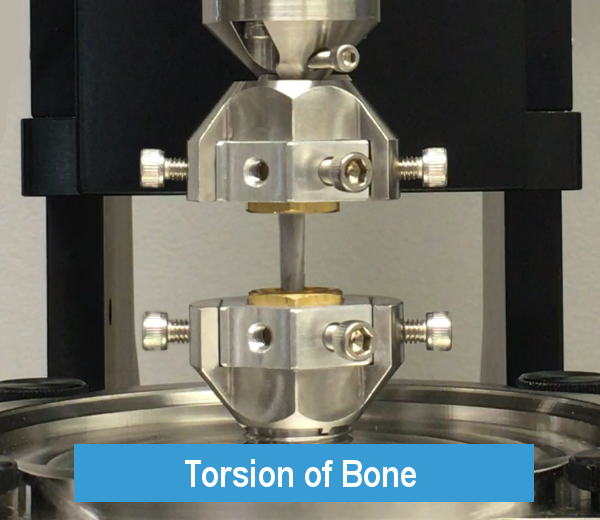
(En anglais seulement) Torsion refers to the twisting of a sample due to an applied torque. Various applications requires materials to withstand torsional stress. It is thus important to test this configuration since material torsional behavior can greatly vary from what is observed under a simple axial constraint. Various mechanical properties can be calculated under this configuration, e.g. the shear modulus, the rupture shear modulus, the yield shear strength, the ultimate (rupture) shear strength and the ductility. The sample could further be evaluated for its resistance to fatigue in torsion.
Lab Modules · 9 chapitres · 21:26
Préparez les disques de caoutchouc et d’hydrogel, réalisez les essais de torsion et analysez les résultats.
Lab Modules · 9 chapitres · 24:50
Suivez le montage des échantillons, les essais de torsion et l’analyse du bois et de l’os.
Tissue testing · 0:35
Démonstration de compression, de cisaillement et de torsion avec le Mach-1.
Kathy K. Lee; Adele Changoor; Marc D. Grynpas; Jane Mitchell
Bone, Volume 208, 2026, 117893, ISSN 8756-3282, July 2026
1 citation · 1 en 2025–2026
Kathy K Lee; Adele Changoor; Marc D Grynpas; Jane Mitchell
JBMR Plus e10841, published: 15 November 2023
5 citations · 5 en 2025–2026
University of Toronto, A thesis submitted in conformity with the requirements for the degree of Doctor of Philosophy, Published: 2023
0 citations · 0 en 2025–2026
Baixuan Yang; Ainara Irastorza-Landa; Peter Heuberger; Heidi-Lynn Ploeg
Journal of the Mechanical Behavior of Biomedical Materials 131 (2022), 105223. Available online 14 April 2022. Publisher PDF deposited by the authors at Queen’s University. Mach-1 directly performed Exp-1 and two post-hoc extreme cases in Exp-2; other Exp-2 tests used Electroforce 3230-AT Series III.
12 citations · 5 en 2025–2026
Baixuan Yang; Ainara Irastorza Landa; Peter Heuberger; Heidi-Lynn Ploeg
World Congress of Biomechanics (WCB), 2022. Original structured conference abstract from the official Queen’s University laboratory site. Mach-1 role: rotary insertion into PU foam. Subsequent cyclic compression used Electroforce 5500.
McGill University. MSc thesis in Human Genetics, March 2022. Original abstract: English.
Oliver Richard Boughton; Jason Bernard; Matthew Szarko
SICOT-J. 2015;1:11.
9 citations · 4 en 2025–2026
(En anglais seulement) This feature is used to obtain the Frequency, Amplitude and Offset of a sinusoidal signal. A blue line displays the theoretical sinusoid with the Frequency, Amplitude and Offset obtained (Figure 1). The values of the Frequency, Amplitude and Offset are indicated in the "Results" field. The units vary according to the graph’s axes.
This feature can also be used for sinusoidal stimulus-response analysis. Sinusoidal stimulus shall be selected on the x-axis and the sinusoidal response on the y-axis. The Modulus is the ratio of the response Amplitude over the stimulus Amplitude. The Phase is the phase difference between the response and the stimulus. The Modulus’ is computed as the Modulus*Cos(Phase) and the Modulus” is computed as the Modulus*Sin(Phase). A blue line displays the theoretical sinusoidal stimulus-response with the Frequency, Modulus and Phase obtained (Figure 2). The values of the Modulus and Phase are indicated in the “Results” field. The units vary according to the graph’s axes.
One use for this feature would be to compute material properties by multiplying the Modulus obtained by the appropriate geometric factors. For example, the Young’s Modulus can be obtained during uniaxial compression or tension on cylindrical sample with t/pi*r2 as the geometric factor, t is the thickness and r is the radius of the sample.
Mach-1 Analysis – Sinusoid – Exemple d’analyse stimulus-réponse