
Configurations de test
Compression confinée

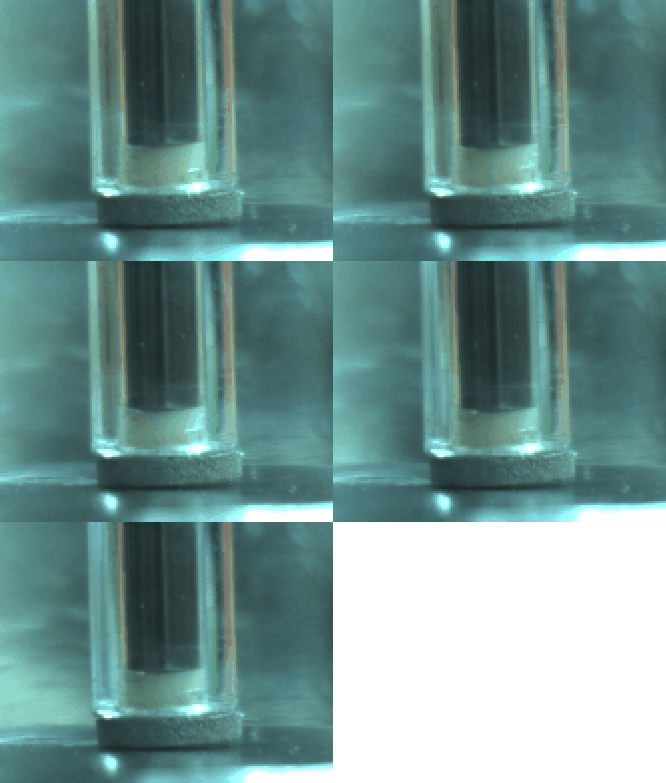
1 / 2
(En anglais seulement) Confined compression testing measures the capacity of a material to withstand axial compressive loads without expanding perpendicularly to the force. Confined compression tests are usually performed on biphasic materials (one phase being liquid) (e.g. poroelastic materials). This test is generally conducted in a closed cylindrical chamber where the sample completely fills the chamber volume. A piston is used to apply stress to the sample. With the liquid phase being incompressible, at least one wall of the confined compression chamber must be porous to deform the material. The aggregate modulus (Ha) corresponds to the stiffness of the material at equilibrium when fluid has ceased flowing through it.
Testeur recommandé (1)
Accessoires (8)


Études de cas (2)

Ressources associées (4)
FAQ
Qu'est-ce que le module d'Young E?
Propriété mécanique intrinsèque d'un matériau indépendant de sa géométrie. Correspond à la pente du stress par rapport à la contrainte pendant une compression non-confiné lorsqu'on tiens compte de la géométrie de l'échantillon.
Module de laboratoire — Compression non confinée de disques d’hydrogel
Qu'est-ce que la poroelasticité?
Propriété d'un matériau élastique ou viscoélastique avec une phase fluide libre incompressible. Lorsqu'un tel matériau est mis sous le stress, le fluide interstitiel est relâché de la matrice solide. La friction générée par le mouvement du fluide à travers la matrice poreuse affecte le comportement mécanique d'un tel matériau. Ces matériaux sont normalement testés dans un bain de fluide.
Mach-1 Analysis – Modèle poroélastique en compression non-confinée – Paramètres
Mach-1 Analysis – Modèle poroélastique en compression confinée – Paramètres
Mach-1 Analysis – Modèle poroélastique en compression confinée – Exemple
Mach-1 Analysis – Modèle poroélastique en compression non-confinée – Cartilage
Mach-1 Analysis – Modèle poroélastique en compression non-confinée – Exemple
LAB MODULE – Torsion of Disk-Shaped Samples – Student Version
Qu'est-ce que la contrainte de cisaillement?
La contrainte de cisaillement est une contrainte mécanique appliquée de manière parallèle ou tangentielle à une face d'un matériau, par opposition aux contraintes normales qui sont appliquées de manière perpendiculaire. C'est le rapport d'une force à une surface. Ses unités sont des Pa.
t =F/A, où t = contrainte de cisaillement, F est la force tangentielle appliquée et A est l'aire de la section tangentielle à la force.
Module de laboratoire — Torsion de l’os
Module de laboratoire — Torsion d’échantillons en forme de disque
LAB MODULE – Torsion of Bone – Student Version
LAB MODULE – Torsion of Disk-Shaped Samples – Student Version
Qu'est-ce que le module de cisaillement?
Le module de cisaillement G est une propriété mécanique d'un matériau. Il est indépendant de la géométrie du matériau. Il représente la rigidité d'un matériau sous une force parallèle à l'une de ses surfaces tandis que sa face opposée présente une force opposée. Le module de cisaillement G est décrit comme la contrainte de cisaillement divisée par la deformation de cisaillement. le module de cisaillement est extrapolé de la régression linéaire entre la contrainte de cisaillement à l'équilibre et la deformation de cisaillement.
Module de laboratoire — Torsion de l’os
Module de laboratoire — Torsion d’échantillons en forme de disque
LAB MODULE – Torsion of Bone – Student Version
LAB MODULE – Torsion of Disk-Shaped Samples – Student Version
Comment fonctionne le modèle poroélastique en compression confinée "Poroelastic Model in Confined Compression"?
(En anglais seulement) This tool allows for the computing and visualizing of the aggregate modulus (MPa), the permeability (mm2/MPa·s) and the mean square error (RMSE) of the fit calculated from a “Stress Relaxation” curve (load or force vs. time) in confined compression (Figure 1) on a disk sample. The curve is fitted to the linear biphasic model (Mow et al., 1980 or Bursać et al., 1999) in order to obtain the mechanical properties of the disk. Sample radius, strain and sample thickness need to be specified.
This model is well adapted for the mechanical characterization of samples containing a liquid fraction and a solid matrix, for example: cartilage or gel samples. A user license is required in order to obtain the results of the poroelastic model in confined compression (Software Add-On, contact Biomomentum to obtain your license).
Mechanical properties can be obtained from the stress relaxation curves obtained under confined compression such as the aggregate modulus (HA) and the hydraulic permeability (k). The aggregate modulus is a measure of stiffness of the sample at equilibrium while the hydraulic permeability is the ability of the fluid to flow through the cartilage matrix.
For example, (Figure 2) shows parameters used for the “Stress Relaxation” function in a confined compression testing protocol on human cartilage disks. Corresponding results are shown in (Figure 1).
Mach-1 Analysis – Modèle poroélastique en compression confinée – Paramètres
Mach-1 Analysis – Modèle poroélastique en compression confinée – Exemple
Qu'est-ce que le module aggrégat?
(En anglais seulement) The aggregate modulus (Ha) corresponds to the stiffness of the material at equilibrium when fluid has ceased flowing through it in a confined compression test configuration. The aggregate modulus can be calculated from Young's modulus (E) and the Poisson ratio (v) using the formula Ha=E(1-v)/[(1+v)(1-2v)].
Quelles sont les caractéristiques de la fonction de relaxation de contrainte (Stress Relaxation)?
(En anglais seulement) The “Stress Relaxation” function allows for applying sequences of ramp-hold displacements as shown in the figure. A sequence of ramp-hold displacements is specified by determining the number of ramps plus the amplitude and velocity of each ramp (the same amplitude and velocity are used for all ramps).
During a “Stress Relaxation” test, a ramp is executed at velocity V and amplitude A, followed by a relaxation (plateau) in which a constant position is held during a time period specified by the user. Several identical ramp-relaxation cycles may be executed one after another.
Parameters:
STAGE AXIS - On multi-axis systems, the user must specify which axis will perform the “Stress Relaxation”.
LOAD CELL AXIS - When using a multiple-axis load cell, the measurement axis can be selected.
Note: The selected “Load Cell Axis” must be consistent with the “Stage Axis”. For example, if the “Vertical (z)” stage axis is selected, the “Load Cell Axis” must have a component along the vertical axis, such as the load along the z axis (the force along z axis or the torque along the x or y axis uses a multiple-axis load cell) in order to eventually attain the “Stop based on” criteria. FAILURE TO MATCH THE “LOAD CELL AXIS” TO THE “STAGE AXIS” CAN RESULT IN DAMAGING OF THE LOAD CELL.
RAMP AMPLITUDE - This is the amplitude that the stage will reach. Full stage range is allowed. A positive amplitude will move the vertical stage down (compression), the horizontal stage, right, and the rotation stage, clockwise. Enter a negative amplitude for opposite directions.
RAMP VELOCITY - This is the velocity at which the stage executes the ramp. Refer to the specifications of your Mach-1™ model to learn of the velocity range allowed. In Mach-1 Motion, the speed is always specified in absolute value terms.
NUMBER OF RAMPS - This is the number of identical displacement/hold cycles to be executed.
STOP BASED ON - There are two ways of determining the end of each relaxation profile (ramp/hold cycle) before applying the next ramp: “Fixed Relaxation Time” and “Relaxation Rate”.
“Fixed Relaxation Time” specifies the duration of each relaxation.
“Relaxation Rate” dynamically monitors the load vs. time slope and ends the relaxation when this slope is less than the “Relaxation Rate per min.” specified by the user. The period over which the slope is calculated is specified by the “Time for Measurement of the Slope, s”. Although a longer period will result in a more accurate slope, keep in mind that the specified relaxation rate can be attained more quickly than the time for measurement of the slope.
FIXED RELAXATION TIME - Specify the relaxation duration when “Fixed Relaxation Time” is selected in the “Stop based on” menu.
RELAXATION RATE PER MIN - Specify the relaxation rate when “Relaxation Rate” is selected from the “Stop based on” menu. The units are grams per minute or newtons per minute, depending on the load measurement units of the selected load cell.
TIME FOR MEASUREMENT OF THE SLOPE - Specify the period over which the relaxation slope is calculated when “Relaxation Rate” is selected in the “Stop based on” menu.
Mach-1 Motion – Fenêtre de la fonction Stress Relaxation
Mach-1 Motion-Stress Relaxation-Position typique en fonction de la courbe de tem
Qu'est-ce que la viscoélasticité?
Propriété d'un matériau présentant des caractéristiques visqueuses et élastiques sous déformation. Un tel matériau montrera un comportement mécanique dépendant du temps.
LAB MODULE – Torsion of Disk-Shaped Samples – Student Version
Qu'est-ce que le taux de déformation?
Taux de la déformation d'un matériau par rapport au temps.
Qu'est-ce que l'élasticité?
Propriété d'un matériau à déformer sous déformation ou contrainte et revenir à sa forme originale lorsque la contrainte est relâché.
Module de laboratoire — Torsion de l’os
LAB MODULE – Unconfined Compression of Hydrogel Disks – Student Version