Emanuele Luigi Carniel; Chiara Giulia Fontanella; Maria Vittoria Mascolini; Sofia Pettenuzzo; Ilaria Toniolo; Alice Berardo
Research article, Volume 11, Issue 10e43430, Published: May 2025
https://doi.org/10.1016/j.heliyon.2025.e43430
2 citations · 2 en 2025–2026
Les titres, résumés et légendes des publications sont présentés en anglais.
Abstract
Meta-materials are an innovative tool for engineering applications, made possible by advanced computational methods for designing meso-structural organization and additive manufacturing techniques that can produce meso-structures unattainable with traditional manufacturing methods. One significant application of meta-materials is in tissue engineering. They offer the capability to mimic tissue configurations at the meso-structural level and replicate mechanical properties, making them invaluable in this field.
This work proposes a computational mechanics framework to characterize and parameterize the mechanical behavior of meta-materials that potentially can mimic the adipose tissue. The approach begins by identifying key parameters that define the mechanical response, followed by determining meso-structural factors that may influence these parameters. Computational analyses are then employed to quantify the influence of these factors on the parameters. The results obtained from these analyses form the basis for accurately identifying the meso-structural configuration of the meta-material, tailored to specific application requirements.
A specific meta-material is proposed to replicate the meso-structural architecture and mechanical properties of adipose tissue, considering both compressive and indentation responses. The application of the computational procedure suggests the potential of the meta-material to be exploited as a scaffold for soft tissue engineering.
A preliminary experimentation has been performed, just to qualitatively compare experimental and model results and to evaluate
the reliability of the computational investigations. A cubic meta-material sample was fabricated by additive manufacturing using a
J850 Digital Anatomy™ 3D printer (Stratasys, Eden Prairie, MN, USA). Five fundamental cells were repeated in the three spatial
directions. The fundamental cell was characterized by cell length L = 1.25 mm, lobule radius R = 1.5 mm and septa of thickness s =
0.15 mm. The specimens were made of a user-defined material designed using the GrabCAD Digital Anatomy Creator 1.73 software
(GrabCAD-Stratasys, Cambridge, MA, USA). Specifically, a combination of two materials was used, namely Agilus30 and BoneMatrix. The mix was designed to give an initial Young modulus of approximately 1 kPa. The mechanical behavior of the structure was
then analyzed experimentally using a Biomomentum Mach-1 v500csst testing machine (Biomomentum Inc., Canada). The tests were
carried out by applying a compressive load with a maximum displacement of 6 mm and a speed of 0.06 mm/s. Experimental data from
the mechanical test, together with computational results from the simulation performed assuming a corresponding
conformation of the fundamental cell.
Utilisation des équipements
Le Mach-1 mesurait la réponse en compression d’une structure de métamatériau imprimée pour la comparer aux prédictions numériques.
Article et documents
Document
Consulter l’article
Matériaux (2)

Matériau
Matériau par impression 3D
Matériau
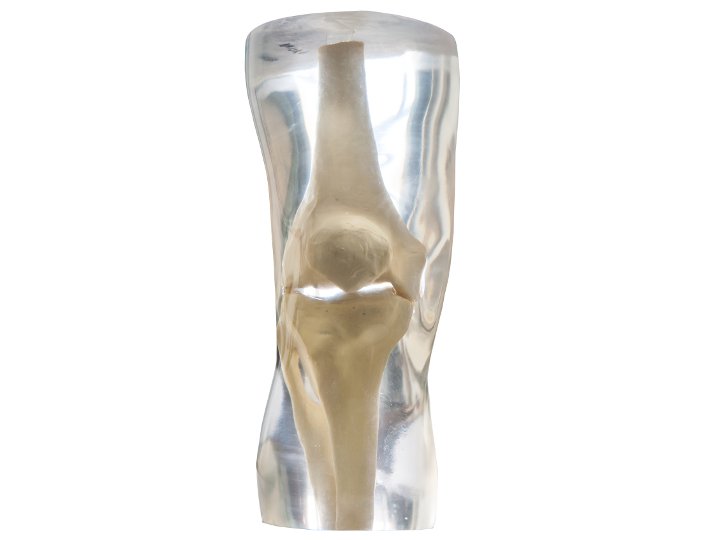
Tissus mous (fantôme)
Configurations de test (4)

Configuration de test
Compression Non-Confinée

Configuration de test
Compression et Torsion simultanée

Configuration de test
Compression confinée

Configuration de test