Eunyoung Cho
Ryerson University. MASc thesis, 2021. Original cover and repository Year field: 2021; Scholar export: 2023. Silicone phantom materials were tested; no human tissue was mechanically tested. Original abstract: English.
https://doi.org/10.32920/24192195.v1
0 citations · 0 en 2025–2026
Les titres, résumés et légendes des publications sont présentés en anglais.
The accuracy of MRI in obstetric settings is often limited by motion artifacts from frequent and spontaneous fetal gross body movement. Development of new MR sequences that avoid these artifacts pivots on extensive testing. Development of an MRI phantom that simulates fetal tissue properties, anatomical structures, and gross body motion will allow for rapid testing, along with reproducible data that will shorten the development time of such MR sequences. This thesis proposes an anthropomorphic MRI phantom of fetal gross body and brain that simulates MR imaging properties, dielectric properties, and the anatomical shape. Various experiments, including relaxometry, dielectric, and mechanical tests, were performed to determine the most appropriate tissue-mimicking material for simulating properties of tissues of interest. For simulating the anatomical shape, MRI data of a 35-week fetus was used to reconstruct a 3D model applied for designing and 3D printing of the phantom molds.
Utilisation des équipements
Un Mach-1 à deux axes, équipé d’une cellule à six composantes, caractérisait les silicones d’un fantôme IRM fœtal. La compression non confinée comportait cinq paliers de 2 % jusqu’à 10 %; le cisaillement comportait cinq paliers de 1 % jusqu’à 5 %. La relaxation fournissait les modules à l’équilibre.
Matériaux (2)

Caoutchouc et élastomère
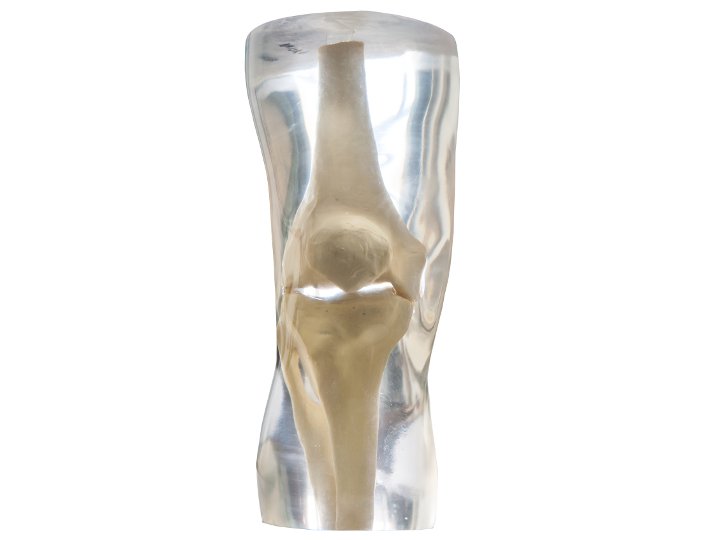
Tissus mous (fantôme)
Configurations de test (3)

Compression Non-Confinée
