Sidaty El Hadramy; Nicolas Padoy; Stéphane Cotin
Computational Biomechanics Workshop at MICCAI 2024, Oct 2024, Marrakech, Morocco., Submitted on 17 Jul 2024
2 citations · 2 en 2025–2026
Les titres, résumés et légendes des publications sont présentés en anglais.
Abstract:
Physics-based Patient-Specific Biomechanical models (PSBMs), particularly those using finite element methods (FEM), simulate organ behaviors accurately but are computationally intensive, especially for hyper-elastic tissues. To address this, U-Mesh introduced a data-driven approach using U-Net architecture, achieving real-time inference but reliant on precise stiffness knowledge at training. This paper introduces HyperU-Mesh, an extension that integrates a Hypernetwork to condition U-Mesh based on stiffness prior distributions. By training with FEM-simulated data that varies stiffness under a predefined distribution, HyperU-Mesh ensures accuracy across variable stiffness without retraining. Experimental results highlight its effectiveness across different scenarios, showing comparable accuracy to FEM while significantly improving speed.
Experiments
PDMS Beam
We aim to estimate the deformation of a PolyDiMethylSiloxane (PDMS) beam under gravity, with the left end fixed to a vertical support. This example, adapted from Mazier et al., involves characterizing the material behavior using the Mach-1™ mechanical testing system (Biomomentum, Canada) for unconfined compression tests. The material is best approximated by a Mooney-Rivlin model with 10 = 101 kPa and 10 = 151 kPa. For validation, we obtained the ground truth deformation data from Mazier et al.
Keywords:
Physics-based biomechanical models, Deep Learning, HyperNetworks.
Utilisation des équipements
Cette étude de modélisation utilise un exemple de poutre en PDMS adapté de Mazier et al. L’exemple décrit une caractérisation en compression non confinée avec le Mach-1 Mechanical Tester pour représenter le comportement du matériau par un modèle de Mooney–Rivlin. Les données de déformation servant à la validation proviennent également de Mazier et al. L’extrait n’établit pas que de nouveaux essais Mach-1 ont été réalisés pour cette étude.
Article et documents
Document
Consulter l’article (PDF)
Matériaux (2)

Matériau
Caoutchouc et élastomère
Matériau
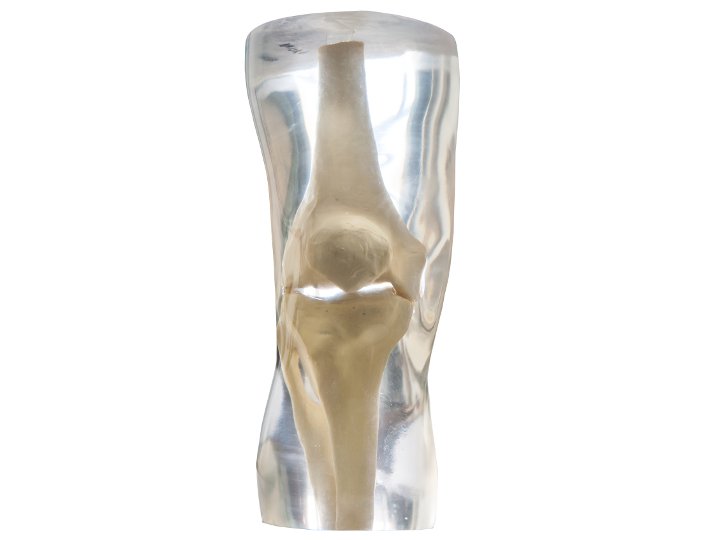
Tissus mous (fantôme)
Configurations de test (1)

Configuration de test