 Voir : Module de laboratoire — Flexion de l’os
Lab Modules · 10 chapitres · 23:26
Module de laboratoire — Flexion de l’os
Découvrez la préparation, les essais de flexion trois points et l’analyse du bois et de l’os.
Configurations de test


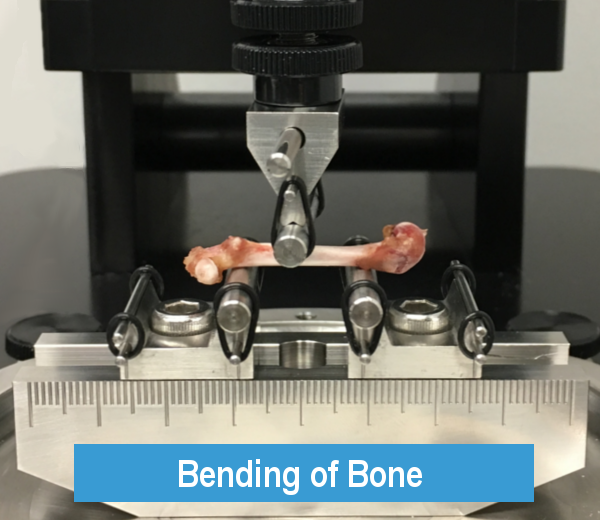
(En anglais seulement) Bending (or flexure) tests characterize the behavior of a slender sample (one dimension being a small fraction – a tenth – of the other two) with load applied perpendicular to its longitudinal axis. This test configuration is particularly useful in evaluating a structural element whose function is to support constraints, e.g. beams or bones. In a 3-point bending test, the sample rests on two support rods placed symmetrically at approximately 75% of the sample’s length, while an upper rod applies vertical deformation to bend the sample at the center between the bottom rods. In a 4-point version, the single upper rod is replaced by two rods, mounted on a central pivot point, placed symmetrically at approximately 25% of the sample’s length. This setup reduces stress concentration observed under the loading point in the 3-point version and distributes it over a larger region between the two loading points, avoiding premature failure of the sample. 4-point bending tests are particularly useful for non-homogeneous materials. Both bending tests provide values for the modulus of elasticity in bending and the flexural stress-strain response of the material.
Voir : Module de laboratoire — Flexion de l’osLab Modules · 10 chapitres · 23:26
Découvrez la préparation, les essais de flexion trois points et l’analyse du bois et de l’os.
 Voir : Flexion sur tibia de souris
Tissue testing · 0:08
Essai de flexion en trois points sur un tibia de souris avec le Mach-1.



Module de laboratoire — Torsion de l’os
Module de laboratoire — Flexion de l’os