Sachin Gunda; Sundararajan Natarajan; Olga Barrera
Journal of the Mechanical Behavior of Biomedical Materials, Volume 143, 2023, 105855, ISSN 1751-6161, Published: 6 May 2023
https://doi.org/10.1016/j.jmbbm.2023.105855
6 citations · 3 en 2025–2026
Les titres, résumés et légendes des publications sont présentés en anglais.
Abstract
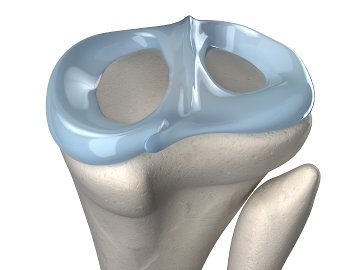
This paper focuses on the origin of the poroelastic anisotropic behaviour of the meniscal tissue and its spatially varying properties. We present confined compression creep test results on samples extracted from three parts of the tissue (Central body, Anterior horn and Posterior horn) in three orientations (Circumferential, Radial and Vertical). We show that a poroelastic model in which the fluid flow evolution is ruled by non-integer order operators (fractional Darcy’s law) provides accurate agreement with the experimental creep data. The model is validated against two additional sets of experimental data: stress relaxation and fluid loss during the consolidation process measured as weight reduction. Results show that the meniscus can be considered as a transversely isotropic poroelastic material. This behaviour is due to the fluid flow rate being about three times higher in the circumferential direction than in the radial and vertical directions in the body region of the meniscus. The 3D fractional poroelastic model is implemented in the finite element software to estimate the weight loss during the confined compression tests.
Keywords
Meniscus; Fractional poroelasticity; Confined compression tests; Anomalous diffusion; Finite element simulation
Utilisation des équipements
Le Mach-1 Mechanical Tester a réalisé des essais de fluage en compression confinée sur des échantillons de ménisque humain provenant du corps central et des cornes antérieure et postérieure, prélevés selon les orientations circonférentielle, radiale et verticale. La chambre limitait le drainage à une plaque poreuse inférieure. Les mesures sous charge constante ont servi à analyser le comportement poroélastique selon l’orientation.
Matériaux (1)
Ménisque
Configurations de test (1)
