Skip to content

Spherical Indenter (D=0.2 mm)

MA032

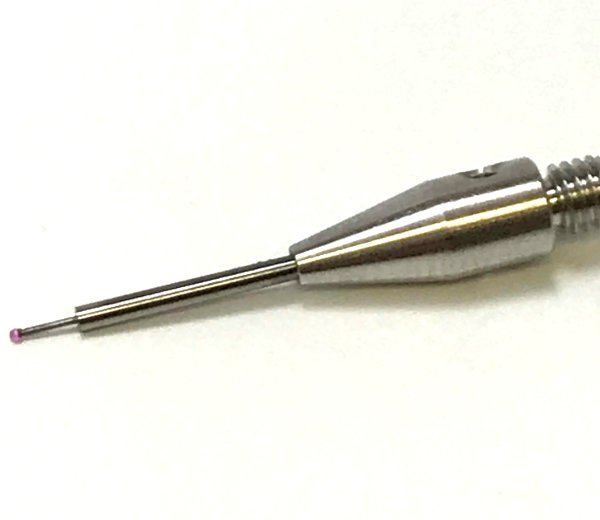
A Spherical Indenter (Ruby ball, D=0.2 mm)

SKU: MA032 Categories: ,

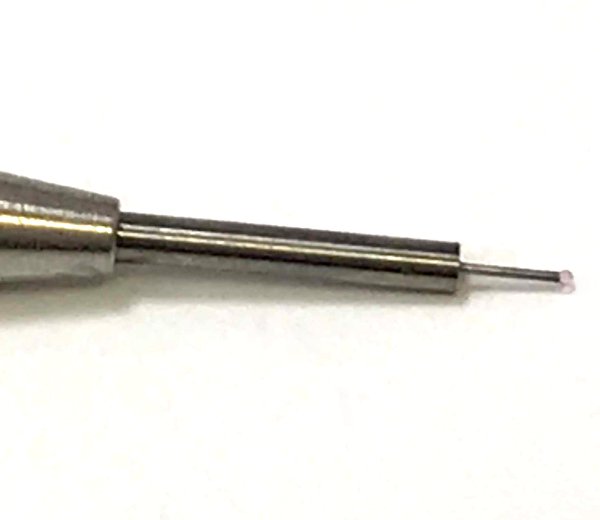
The smaller the indenter diameter, the more the mechanical characterization data will come from the surface of the sample. It is very important to adjust the size of the indenter with the critical size of the sample. Each indenter is made of a highly smooth and spherical ruby ball mounted on a carbide stem and stainless steel base. Manipulation of the very small indenters should be done with great care since those assemblies are relatively fragile. The Holder for Spherical Indenters (MA031) is required. Images shown are those of the D=0.3mm spherical indenter.

  • This accessory has been designed to facilitate cleaning and desinfection.
  • Designed to be used in contact with physiological saline solution
  • Easy to assemble and mount on the tester
  • The red ruby ball facilitates positioning of the indenter when used with a sample bathed in a solution.
Material

Carbide Stem, Ruby Ball

Diameter

0.2 mm

Upper Attachment

M3 Male Thread

Documents and resources (1)

Test configurations (5)

FAQ

How does the "Elastic Model in Indentation" works?

This tool allows for the computing and visualizing of the shear modulus (MPa) and the Young’s modulus (MPa) from an indentation test performed using a spherical indenter (Figure 1). This model is well adapted for the mechanical characterization of samples (with critical diameter (width) at least 5 times the indenter diameter) bonded on a flat rigid support (at least 10 times stiffer than the sample), for example: any sheet of material lying on a rigid chamber base (limited sliding at the interface can be assumed) or a cartilage layer attached to a thick sub-chondral bone. A user license is required to obtain the results of the elastic model in indentation (Software Add-On, contact Biomomentum to obtain your license).

Results analysis is performed considering the indentation mechanics of an infinitely wide elastic layer bonded to a rigid half-space which has been developed as a model for the layered geometry of cartilage and subchondral bone (Hayes et al., 1972). (Figure 2) shows a schematic representing the modeled situation.

Many parameters need to be specified in order to calculate the different material properties.

1. Indenter Shape is:

  • Spherical
  • Plane-Ended Cylindrical

2. Indenter radius in mm.

3. Poisson ratio can be selected from a drop-down list (Figure 3)


4. Position @ contact is – defines the position of the left cursor:

  • to be curvefit – will automatically find the position contact which will give the smallest mean squared error (mse)
  • the value at t0 – will automatically take the position contact at the start of the curve
  • the following value (mm) – the user need to specify the value in the corresponding field next to the drop-down list
  • cursor position – the user can drag the left cursor to the wanted position contact

5. Sample thickness is the:

  • position @ contact – will automatically find the position at contact (position of the left cursor)
  • following value (mm) – the user need to specify the value in the corresponding field next to the drop-down list

6. Curvefit is up to – defines the position of the right cursor:

  • peak load – will automatically take the position of the peak load
  • delta load (unit) – the user need to specify the value of the desired delta load in the corresponding field next to the drop-down list
  • delta position (mm) – the user need to specify the value of the desired delta position in the corresponding field next to the drop-down list

The error on the estimation of the best curve representing the stress relaxation curve is calculated using the root of the mean squares (RMS) method and is displayed under “RMSE”. For example, (Figure 4) shows parameters used for the “Normal Indentation” (Mach-1 Motion) function in an indentation testing protocol on ovine articular surfaces. Corresponding results are shown in (Figure 1).

Spherical Indentation Guide – Mach-1 Mechanical Tester – Biomomentum

Mach-1 Analysis – Elastic Model in Indentation – Parameters

Mach-1 Analysis – Elastic Model in Indentation – Poisson ratio choices

Mach-1 Analysis – Elastic Model in Indentation – Cartilage & Subchondral bone

Mach-1 Analysis – Elastic Model in Indentation – Example

How does the Normal Indentation function works?
This function precisely detects the height and orientation of the surface of the sample at the XY position and records the load (for multiaxial load cell only) while simultaneously moving the three linear stages at different speeds in order to move a spherical indenter with a predefined displacement profile along a virtual axis normal to the surface of the sample.

Parameters:
Z-CONTACT CRITERIA - The user specifies the load to be reached until the stage stops moving. The software analyzes the load-displacement curve and moves the stage back to the position where the load had started to increase (twice the load cell resolution) (refer to Find Contact function description).
SCANNING GRID - Specify the distance "d" from the test location of the 4 control points at the surface in the vicinity of the test location (xi,yi) = (-d,0), (d,0), (0,-d) and (0,d).
INDENTATION AMPLITUDE - This is the amplitude of the normal indentation. Full stage range is allowed. A positive amplitude will move the indenter toward the sample (compression).
INDENTATION VELOCITY - This is the velocity of the normal indentation. Refer to the specifications of your Mach-1™ model to learn of the velocity range allowed. In Mach-1 Motion, the speed is always specified in absolute value terms.
RELAXATION TIME - This is the time period during which the position is maintained at the commanded amplitude (relaxation period).

Spherical Indentation Guide – Mach-1 Mechanical Tester – Biomomentum

Mach-1 Motion – Normal Indentation Window

Need Help Choosing an Accessory?

Talk to our team

Report a problem with this page

Your email is used only to follow up on this report.

Screenshots (optional)

Click this area and paste a screenshot, or drag files here. Up to 3 PNG, JPEG or WebP images; 5 MB per image. Hide confidential information first.

Please do not include passwords or customer information. Reports and screenshots are private.