Sijia Zheng; Michael A. Brook
CS Appl. Polym. Mater. 2021, XXXX, XXX, XXX-XXX Publication Date:March 29, 2021
https://doi.org/10.1021/acsapm.1c00101
4 citations · 0 in 2025–2026
Abstract
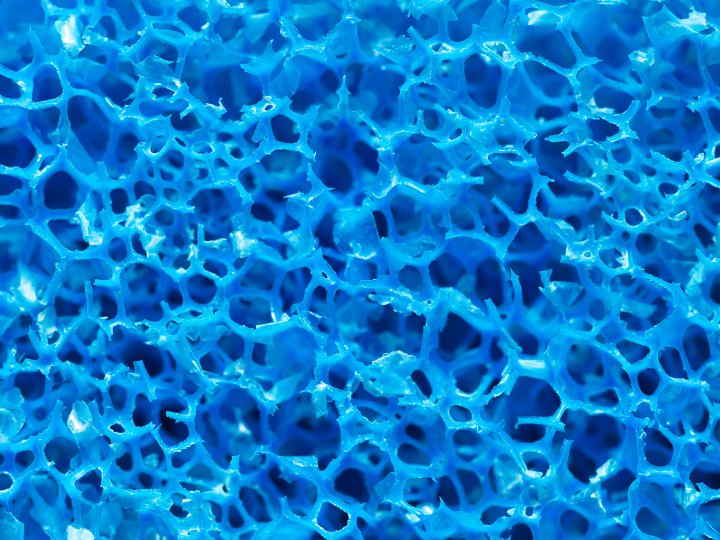
Topical disinfection protocols to inactivate organisms, particularly on high contact surfaces, have become increasingly important. A classical oxidative agent, sodium hypochlorite (bleach), has many benefits, but can be problematic during applications because of its ability to oxidize the organic polymers in which it is contained. We demonstrate that bleach-containing elastomeric sponges are readily created in one step at room temperature from thiopropyl-modified silicone oils; sodium hypochlorite induces disulfide cross-linking and a foam structure due, in part, to the concomitant formation of sulfonates. No surfactants are required. The morphology of the bleach-containing silicone sponge is tunable by the aqueous bleach solution concentration and the water/silicone ratio used. The resulting silicone sponge contains excess bleach that can be released gradually, as shown by its ability to oxidize organic molecules in aqueous solution, either directly or after dehydration/rehydration; the latter process provides a way to store the bleach-containing material in dry form. Such foams exhibit enhanced sustainability as, we show, they can be converted back to thiopropylsilicone oils by reduction using hydrosilicones. The resulting oils can be re-cross-linked, completing the life cycle.
The Young’s moduli of foam samples were determined from an indentation test using an MACH-1 micromechanical system (Biomomentum Instruments) with a 0.500 mm hemispherical indenter radius, and a typical Poisson ratio of 0.5 for elastomeric silicone material was used in the calculation moldel.
KEYWORDS: silicone foam surfactant-free thiol oxidation bleach delivery disulfide cleavage
Equipment used
The Mach-1 Mechanical Tester measured Young’s modulus of silicone foam specimens by indentation.
Materials (1)
Material
Foam
Test configurations (1)

Test configuration