Baixuan Yang; Ainara Irastorza-Landa; Peter Heuberger; Heidi-Lynn Ploeg
Journal of the Mechanical Behavior of Biomedical Materials 131 (2022), 105223. Available online 14 April 2022. Publisher PDF deposited by the authors at Queen’s University. Mach-1 directly performed Exp-1 and two post-hoc extreme cases in Exp-2; other Exp-2 tests used Electroforce 3230-AT Series III.
https://doi.org/10.1016/j.jmbbm.2022.105223
12 citations · 5 en 2025–2026
Les titres, résumés et légendes des publications sont présentés en anglais.
Maximum insertion torque (IT) for threaded dental implants is a primary clinical measurement to assess implant anchorage, and strongly influences the clinical outcome. Insertion torque is influenced by surgical technique, implant designs, and patient factors such as bone density and quality. In this study, an analytical model was proposed for IT to estimate contributions from the thread and taper separately. The purpose of this study was to test if the analytical model could 1. differentiate the parallel-walled and tapered implant; and, 2. represent four factors: bone surrogate density, drill protocol, implant surface finish and cutting flute. The IT was modeled as the sum of the torques from the thread’s inclined plane and interface shear stress from the tapered body integrated over the surface area, respectively, with two main parameters: effective force, F′, F′ and effective pressure, p′. The effective force, relates to the clamping force from the thread, while the effective pressure, p′, associates with the contact pressure at the bone-implant interface. The model performed well (R² = 0.88–1.0) and differentiated between the parallel-walled (p′ = 0) and tapered implants (p′ = 0.12). The model’s parameters could individually represent the effects of the four factors. High bone surrogate density, two-step drill protocol, and rough surface increased both F′ and p′. The cutting flute had opposing effects on F′ and p′ (β₄ = 0.35 and −0.24, respectively); and therefore, had the lowest net effect on IT. The proposed analytical model therefore improves the understanding of the principal contributors to dental implant IT by considering thread and taper mechanics independently.
Utilisation des équipements
Un Mach-1 V500CST mesurait le couple d’insertion d’implants dentaires dans une mousse rigide de polyuréthane : implants cylindriques et coniques à 12 tr/min, puis deux cas à couple élevé à 7,5 tr/min. Les autres essais factoriels utilisaient un Electroforce. Torsion désigne l’insertion rotative, pas un essai de torsion pure.
Matériaux (1)
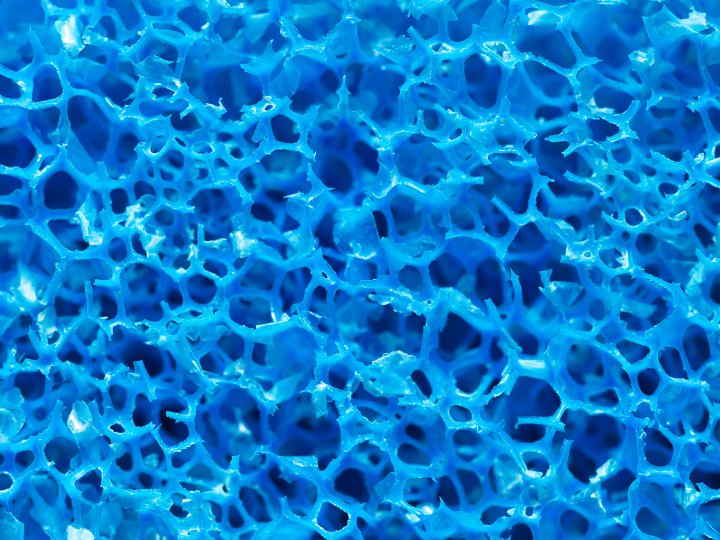
Mousse
Configurations de test (1)
