Des changements dans la concentration de calcium altère les propriétés mécaniques du disque intervertébral
(En anglais seulement) Since we recently discovered that increased free calcium (Ca2+) concentration in the human intervertebral disc (IVD) leads to matrix degradation (Grant et al. ECM 2016), we hypothesized that elevations in Ca2+ also impair IVD mechanics. The aim of this study was to determine the effect of free Ca2+ on the mechanical properties of the IVD.
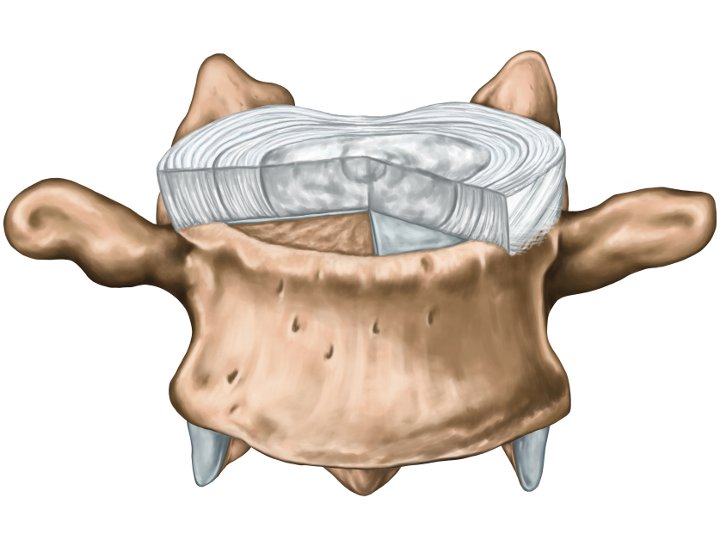
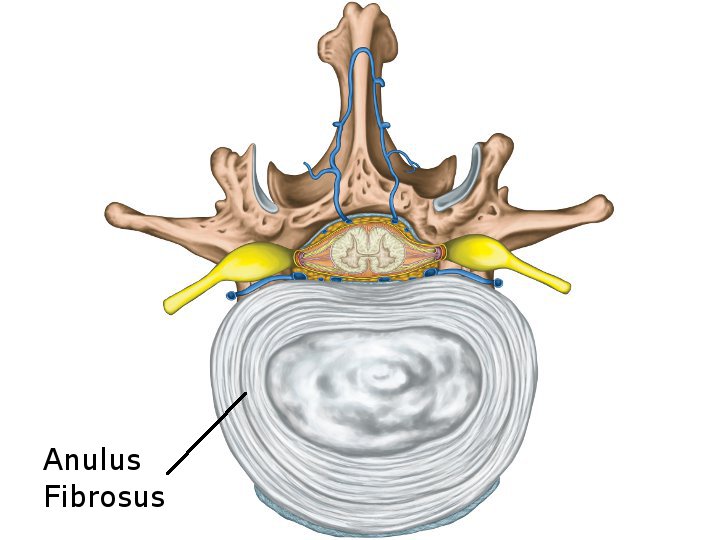
IVDs were isolated from 25monthold bovine tails and incubated for 4 weeks with either 1mM or 5mM Ca2+. IVDs without calcium supplementation were considered as control. Using the Mach1 mechanical tester (Biomomentum Inc, Canada), each IVD was subjected to compressive dynamic mechanical testing (DMA) to assess its bulk Young's modulus (E*) for frequencies ranging from 0.01Hz to 5Hz using 5% strain amplitude. Subsequently, to assess the compartmental stiffness, the IVDs were divided in two halves along the spinal cord, and the central section of each half was assessed using an automated spherical indentation technique (R=3.2mm, 15 measures/cm2, amplitude=0.5mm). Stiffness maps were generated.
Results: After a 4week incubation period in 1mM or 5mM Ca2+, E* decreased significantly compared to the control. Stiffness of IVD's compartments remained almost unchanged when compared to the control for low Ca2+ concentration (1mM), while it reached significance (p<0.0001) at the high
concentration (5mM). The stiffness decreased in annulus fibrosus (AF) from 0.30±0.02MPa to 0.06±0.01MPa. However, for both nucleus pulposus (NP) and endplates (EP), tissues stiffness increased from 0.030±0.001MPa to 0.060±0.002MPa and from 1.45±0.15MPa to 2.5±0.07MPa,
respectively.
concentration (5mM). The stiffness decreased in annulus fibrosus (AF) from 0.30±0.02MPa to 0.06±0.01MPa. However, for both nucleus pulposus (NP) and endplates (EP), tissues stiffness increased from 0.030±0.001MPa to 0.060±0.002MPa and from 1.45±0.15MPa to 2.5±0.07MPa,
respectively.
Conclusions: High Ca2+ concentration alters IVD's bulk and compartmental mechanical properties. These results are consistent with our previous findings suggesting that increasing the calcium levels resulted in increases in the mineralisation of EP, and decrease the diffusion of nutrient into the disc.
Consequently, assessing mechanical properties of each IVD's compartment may provide a better understanding of its bulk mechanical behavior and its integrity during degeneration.
Consequently, assessing mechanical properties of each IVD's compartment may provide a better understanding of its bulk mechanical behavior and its integrity during degeneration.
Adapted from: I. Hadjab, M.P. Grant, L.M. Epure, M. Garon, E. Quenneville, J. Anthoniou, F. Mwale and M.D. Buschmann. Changes in Free Calcium Alter the Mechanical Properties of the Intervertebral Disc. International Conference on the Mechanics of Biomaterials and Tissues, Hawaii, USA, 12Dec2017, Podium O.48.
Figures

Figure 1 — Afficher la légende
Grille de mesure et carte en couleurs illustrant les propriétés mécaniques régionales d’un disque intervertébral.

Figure 2 — Afficher la légende
Cartographies de rigidité des disques après quatre semaines en condition témoin et avec supplémentation en calcium.

Figure 3 — Afficher la légende
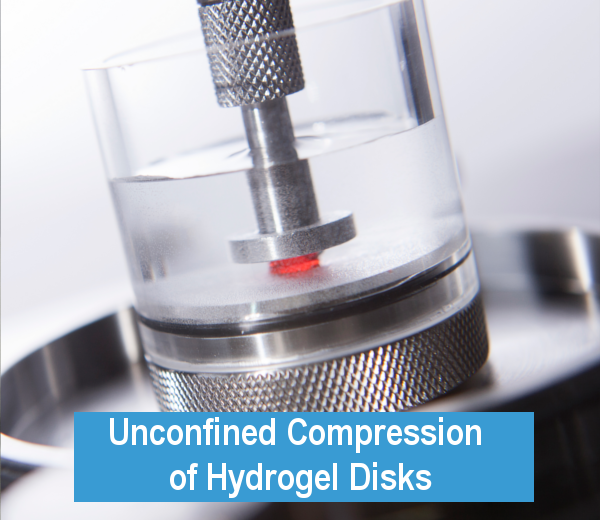
Montage de compression et module de Young dynamique des disques sous différentes conditions de calcium.

Figure 4 — Afficher la légende
Rigidité des plateaux, de l’anneau fibreux et du noyau pulpeux dans les conditions présentées.
Produits (3)


Accessoires (20)



Configurations de test (5)

Configuration de test
Cartographie 3D en indentation normale

Configuration de test
Compression Non-Confinée

Configuration de test
Indentation (Raideur)

Configuration de test
Flux de caméra

Configuration de test