 Watch: Lab Module — Torsion of disk-shaped samples
Lab Modules · 9 chapters · 21:26
Lab Module — Torsion of disk-shaped samples
Prepare rubber and hydrogel disks, perform torsion tests and analyse the results.
Test configurations


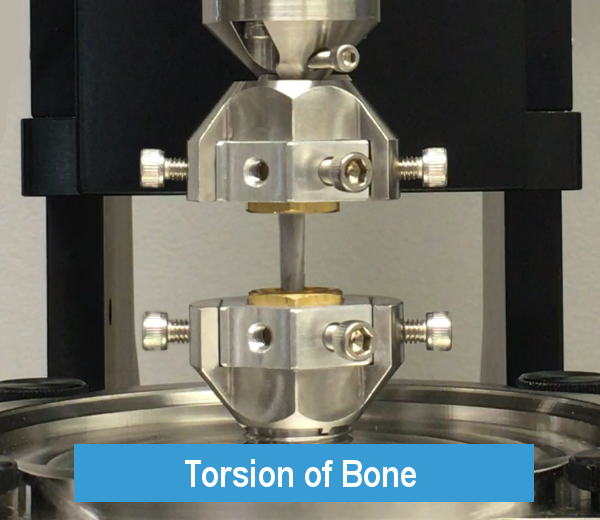
Torsion refers to the twisting of a sample due to an applied torque. Various applications requires materials to withstand torsional stress. It is thus important to test this configuration since material torsional behavior can greatly vary from what is observed under a simple axial constraint. Various mechanical properties can be calculated under this configuration, e.g. the shear modulus, the rupture shear modulus, the yield shear strength, the ultimate (rupture) shear strength and the ductility. The sample could further be evaluated for its resistance to fatigue in torsion.
Watch: Lab Module — Torsion of disk-shaped samplesLab Modules · 9 chapters · 21:26
Prepare rubber and hydrogel disks, perform torsion tests and analyse the results.
 Watch: Lab Module — Torsion of bone
Lab Modules · 9 chapters · 24:50
Follow specimen mounting, torsion tests and analysis of wood and bone.
 Watch: Compression, shear and torsion
Tissue testing · 0:35
A demonstration of compression, shear and torsion using the Mach-1.




This feature is used to obtain the Frequency, Amplitude and Offset of a sinusoidal signal. A blue line displays the theoretical sinusoid with the Frequency, Amplitude and Offset obtained (Figure 1). The values of the Frequency, Amplitude and Offset are indicated in the "Results" field. The units vary according to the graph’s axes.
This feature can also be used for sinusoidal stimulus-response analysis. Sinusoidal stimulus shall be selected on the x-axis and the sinusoidal response on the y-axis. The Modulus is the ratio of the response Amplitude over the stimulus Amplitude. The Phase is the phase difference between the response and the stimulus. The Modulus’ is computed as the Modulus*Cos(Phase) and the Modulus” is computed as the Modulus*Sin(Phase). A blue line displays the theoretical sinusoidal stimulus-response with the Frequency, Modulus and Phase obtained (Figure 2). The values of the Modulus and Phase are indicated in the “Results” field. The units vary according to the graph’s axes.
One use for this feature would be to compute material properties by multiplying the Modulus obtained by the appropriate geometric factors. For example, the Young’s Modulus can be obtained during uniaxial compression or tension on cylindrical sample with t/pi*r2 as the geometric factor, t is the thickness and r is the radius of the sample.
Mach-1 Analysis – Sinusoid – Example for stimulus-response analysis
