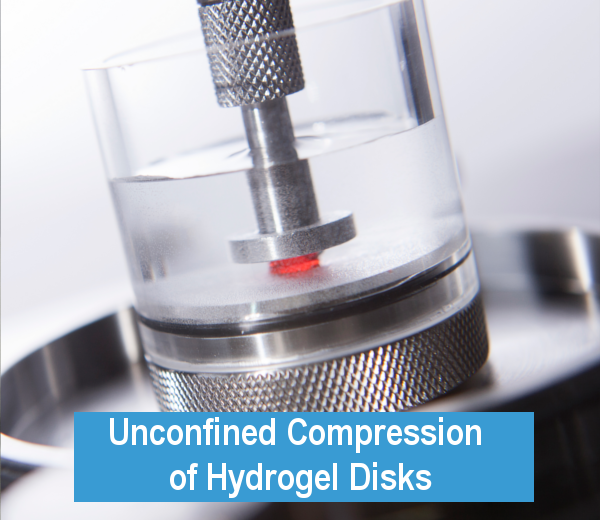
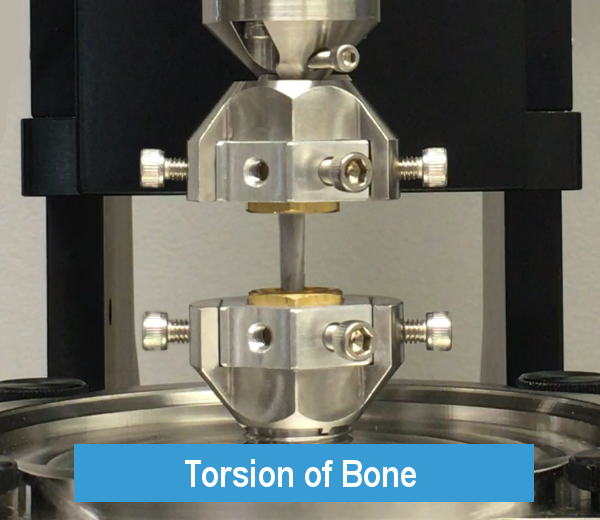
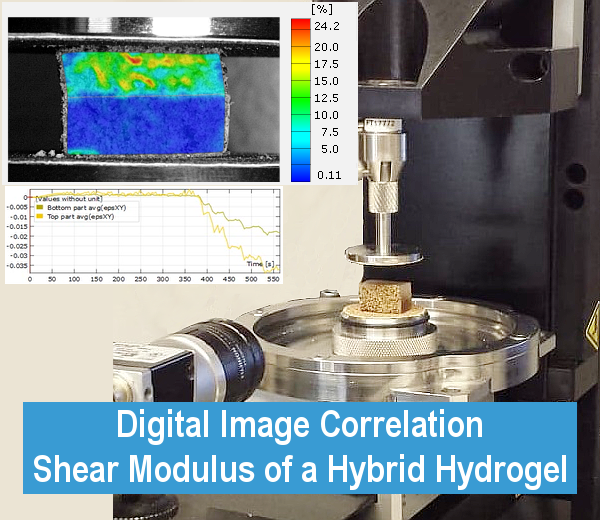
Various applications require materials to withstand torsional stress. In this undergraduate biomechanics class laboratory module, rubber and hydrogel disk-shaped samples will be pre-compressed between two flat platens covered with waterproof sandpaper and a dynamic rotational displacement will be applied. Throughout this laboratory, each team will: prepare rubber and a hydrogel disk samples; test samples in dynamic torsion shear at frequencies from 0.1 to 2Hz; obtain samples’ dynamic moduli from torque-displacement sinusoidal curves; calculate dynamic shear modulus; learn the relevance of the pre-compression; discuss the effect of frequency on the dynamic shear modulus.
Includes syllabus (instructor’s editable version) and turn-key sample preparation kit (e.g. rubber sheet, agar powder, adhesive sandpaper, 11 dermal punches, metal rods, circular stencils) allowing about 10 repetitions (team of 2-5 students).
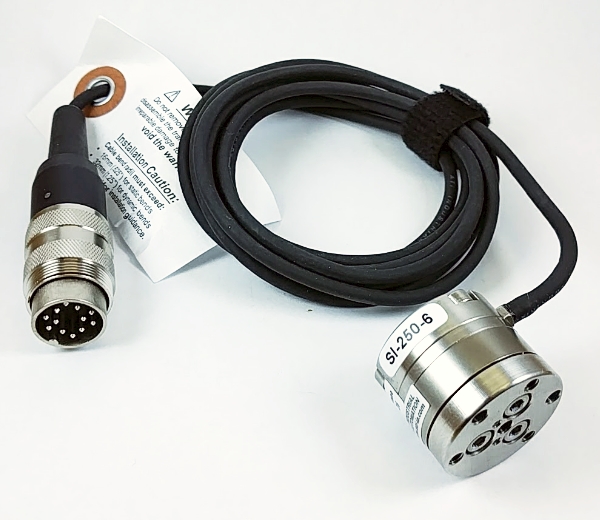
Requires a Mach-1 tester (MA005 or higher), a high capacity multiaxial load cell (MA236), a flat indenter (MA262 or MA263), a small testing chamber (MA740) and a testing chamber (MA626).
- Designed to be used in contact with physiological saline solution
- Deemed an excellent educational tool for students
- Learning Goal – Become familiar with the safe operation of a mechanical tester
- Learning Goal – Learn how to prepare disk-shaped samples
- Learning Goal – Understand how the structure and composition of materials determine their mechanical behavior
- Learning Goal – Learn how to perform a dynamic mechanical test in torsion
- Learning Goal – Understand how to calculate dynamic shear modulus of a disk-shaped sample in dynamic mechanical testing
- Learning Goal – Understand the effect of frequency on the shear modulus