This laboratory material kit for mechanical testing is a turnkey solution to perform Biomomentum’s laboratory module (sample preparation and mechanical testing). Most of these materials are very common in university lab and thus buying is optional. It includes laboratory equipment such as cutting board, 250mL beaker, 100mL graduated cylinder, crystallizing dish, wash bottles, petri dishes, scalpel and blades, large and fine surgical scissors, spatula, some tweezer and forceps. It also includes PBS powder and laboratory tools such as a scale, a caliper, a mallet, scissors, scotch tape, Styrofoam board and sharpies.

Laboratory Material for Mechanical Testing
MA299
A lab module with related accessories for an undergraduate biomechanical class
Documents and resources (1)
Catalogue items




FAQ
What is Young's modulus E?
Intrinsic mechanical property of a material independent of its geometry. From the slope of the stress vs. strain graph during an unconfined compression and considering the geometry of the sample, we can calculate the Young's modulus.
What is Poroelasticity?
Property of an elastic or viscoelastic material with an incompressible free fluid phase. When such a material is put under stress, fluid is released from the solid matrix. The frictional drag generated from the movement of the fluid through the matrix affects the mechanical behavior of such material. These materials are normally tested in a bath of fluid.
Mach-1 Analysis – Poroelastic Model in Unconfined Compression – Parameters
Mach-1 Analysis – Poroelastic Model in Confined Compression – Parameters
Mach-1 Analysis – Poroelastic Model in Confined Compression – Example
Mach-1 Analysis – Poroelastic Model in Unconfined Compression – Cartilage
Mach-1 Analysis – Poroelastic Model in Unconfined Compression – Example
LAB MODULE – Torsion of Disk-Shaped Samples – Student Version
What is the shear stress?
The shear stress is the component of the mechanical stress causing deformation of a material by slippage along a plane or planes parallel to the imposed stress. Shear stress arises from shear forces, which are pairs of equal and opposing forces acting on opposite sides of an object. Units are in Pa.
t =F/A, where t = the shear stress, F = the force applied and A = the cross-sectional area of material with area parallel to the applied force vector.
Lab Module — Torsion of disk-shaped samples
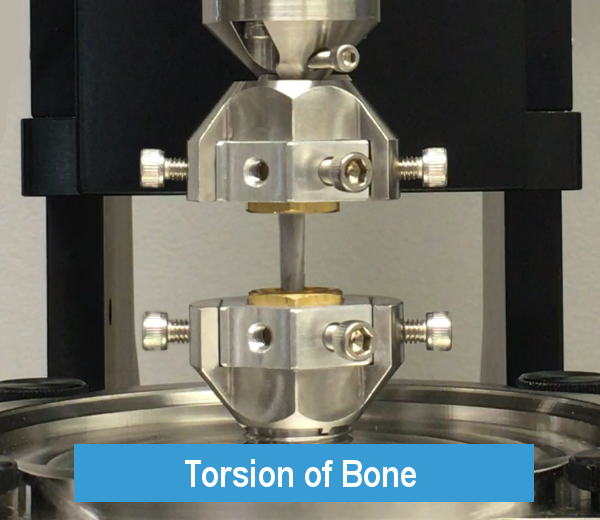
LAB MODULE – Torsion of Bone – Student Version
LAB MODULE – Torsion of Disk-Shaped Samples – Student Version
What is the shear modulus?
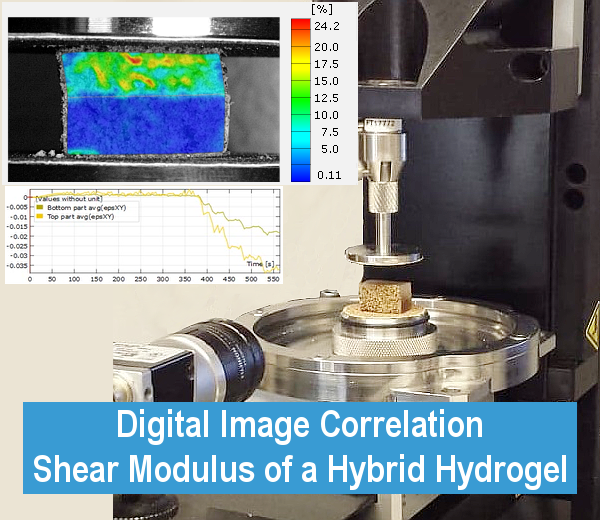
The shear modulus G is a mechanical property of a material. It is independent of the material geometry. It represents the stiffness of a material under a force parallel to one of its surfaces while its opposite face experiences an opposite force. The shear modulus G is described as the shear stress over the shear strain. The shear modulus is extrapolated from the linear regression between shear stress at equilibrium and shear strain.
Lab Module — Torsion of disk-shaped samples
LAB MODULE – Torsion of Bone – Student Version
LAB MODULE – Torsion of Disk-Shaped Samples – Student Version
What is viscoelasticity?
Property of a material to exhibit both viscous and elastic characteristics when undergoing deformation. Such material will show time-dependent mechanical behavior.
LAB MODULE – Torsion of Disk-Shaped Samples – Student Version
What is the strain rate?
Change in strain or deformation of a material with respect to time.
What is the elasticity?
Property of a material to deform under load or strain and to return to its original shape when the stress is released.
LAB MODULE – Unconfined Compression of Hydrogel Disks – Student Version
What is the stiffness K?
A structural property of a sample. By plotting force vs. displacement during an unconfined compression and extracting the slope, we obtain the stiffness of the sample. In Mach-1 Analysis, the slope is in gram-force per mm (gf/mm). The gram-force is 1 gram multiplied by the acceleration due to gravity on Earth, exactly 9.80665 m/s².