Tissue testing · 3:46
Friction testing on an osteochondral core
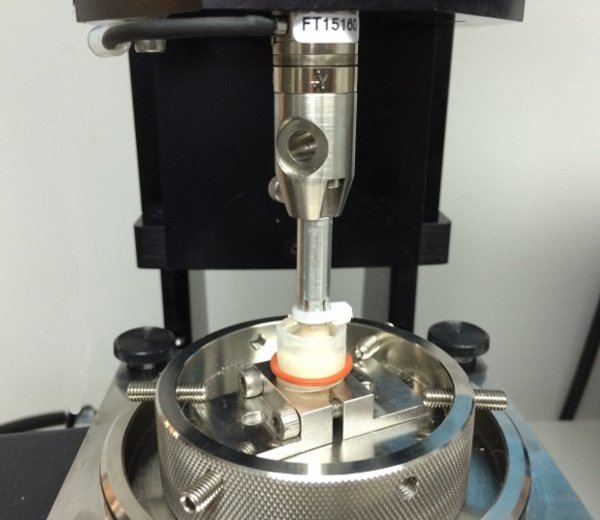
A demonstration of friction testing on an osteochondral core.
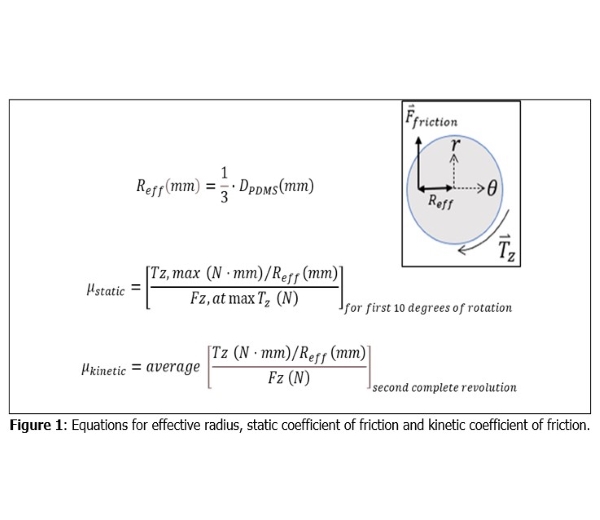
Friction tests determine the ease of two surfaces to slide against each other when subjected to a contact force. Two main phenomenons are generally observed during these tests: static and kinetic friction. Static friction is the force preventing an object from moving from rest, while kinetic friction is the force acting between two surfaces when they are already in motion. Using the vertical stage to apply a normal force and the other stages to apply either rotational or translational movements, the software developed by Biomomentum allows you to easily determine the coefficient of friction and the forces involved in the tests. The purposes of friction testing cover a large field of interests. For example, testing the effectiveness of a new type of lubricant or comparing the surface properties of two samples.
Tissue testing · 3:46
A demonstration of friction testing on an osteochondral core.
Lisa Yamaura; Jessica May Corpuz; Joshua Mang; Roman Krawetz
Osteoarthritis and Cartilage Open, 2026, 100864, ISSN 2665-9131, Published: 20 August 2026
0 citations · 0 in 2025–2026
Laura E. Keller; Terri-Ann N. Kelly; Jacqueline M. Chevalier; Hyung Jin Jung; Garett B. Pearson; Laila Begum; Olivia S. Beane; Sarindr Bhumiratana; Lisa A. Fortier
The American Journal of Sports Medicine. 2026;54(3):622-634, published: February 10, 2026
1 citation · 1 in 2025–2026
Solaleh Miar; Gabriela Gonzales; Gregory Dion; Joo L. Ong; Ronit Malka; Rena Bizios; Ryan C. Branski; Teja Guda
Biomaterials, Volume 309, 2024, 122602, ISSN 0142-9612.
10 citations · 10 in 2025–2026
Amin Joukar; Amy Creecy; Sonali Karnik; Hessam Noori-Dokht; Stephen B. Trippel; Joseph M. Wallace; Diane R. Wagner
Journal of the Mechanical Behavior of Biomedical Materials, 2023, 105827, ISSN 1751-6161, Published: 6 April 202
17 citations · 11 in 2025–2026
Alex Pieters; Renato Castillo; Rodrigue Caron; Colleen Mathieu; Sotcheadt Sim; Martin Garon
Orthopeadic Research Society Annual Meeting in Dallas, 2023
Colleen Mathieu; Yasaman Pooshidani; Renato Castillo; Jasmine Doan; Sotcheadt Sim; Eric Quenneville; Martin Garon
Yan Shi; Jia Liu; Jianliang Li; Dangsheng Xiong; Daniele Dini
Journal of Polymer Research, volume 29, Article number: 515, Published: 19 November 2022
13 citations · 9 in 2025–2026
Austyn R. Matheson; Eamon J. Sheehy; Gregory D. Jay; W. Michael Scott; Fergal J. O'Brien; Tannin A. Schmidt
Journal of the Mechanical Behavior of Biomedical Materials, 2021, 104445, ISSN 1751-6161, https://doi.org/10.1016/j.jmbbm.2021.104445
11 citations · 6 in 2025–2026
Zinan He; Rosaire Mongrain; Simon Lessard; Boris Chayer; Guy Cloutier; Gilles Soulez
Medical Engineering and Physics 77 (2020), 60–68. Original publisher PDF hosted by the author laboratory (LBUM, CRCHUM). Electronic publication date 15 January 2020 confirmed by PubMed 31954613. Original abstract: English. Human detail applies to the surgical AAA tissue, not the synthetic hydrogel or silicone. Tensile tests were performed using a Bose Enduratec ELF 3200, not Mach-1.
4 citations · 2 in 2025–2026
PhD thesis, University of Calgary, 2020 (degree/title-page year).
0 citations · 0 in 2025–2026
Zhengchu Tan; Daniele Dini; Ferdinando Rodriguez y Baena; Antonio Elia Forte
Materials & Design, 160, 886–894. https://doi.org/10.1016/j.matdes.2018.10.018
65 citations · 13 in 2025–2026
Sim S; Hadjab I; Chevrolat L-A; Masse M; Tong AL; Lavigne P; Garon M; Quenneville E; Buschmann MD
Accepted for a podium presentation at ORS 2017
Master thesis. University of Calgary, Calgary, AB. doi:10.11575/PRISM/5357 http://hdl.handle.net/1880/106276
0 citations · 0 in 2025–2026
Hsu FH; Alonso E; Raleigh AR; Saleh AA; Masuda K; Lotz MK; Chen AC; Sah R
Orthopeadic Research Society Annual Meeting, 2016, Orlando, USA, Poster abstract 1428
Sim S; Chartrand A; Lavallee AP; Tessier J; Garon M; Quenneville E; Buschmann MD
Orthopeadic Research Society Annual Meeting in Orlando, 2016
Steven Elder; Amanda Pinheiro; Christian Young; Preston Smith; Emily Wright
J Orthop Res. 2016 Nov 18. doi: 10.1002/jor.23483
34 citations · 5 in 2025–2026
Christoph Meinert; Karsten Schrobback; Peter A. Levett; Cameron Lutton; Robert L. Sah; Travis J. Klein
Acta biomaterialia, October 2016. DOI: 10.1016/j.actbio.2016.10.011
22 citations · 2 in 2025–2026
Hsu FH; Hui AY; Chen AC; Lotz MK; Sah R
Orthopeadic Research Society Annual Meeting in Las Vegas, Abstract 0256
Darvin J. Griffin; Edward D. Bonnevie; Devin J. Lachowsky; James C.A. Hart; Holly D. Sparks; Nance Moran; Gloria Matthews; Alan J. Nixon; Itai Cohen; Lawrence J. Bonassar
Journal of biomechanics, 48(10), 1944-1949. (2015)
59 citations · 8 in 2025–2026
Quynhhoa T. Nguyen; Benjamin L. Wong; June Chun; Yeoung C. Yoon; Frank E. Talke; Robert L. Sah
Journal of biomechanics. 2010;43(9):1787-1793.
12 citations · 1 in 2025–2026
Osteoarthritis Cartilage. 2007 Jan;15(1):35-47. Epub 2006 Jul 21
208 citations · 13 in 2025–2026
This feature is used to obtain the Frequency, Amplitude and Offset of a sinusoidal signal. A blue line displays the theoretical sinusoid with the Frequency, Amplitude and Offset obtained (Figure 1). The values of the Frequency, Amplitude and Offset are indicated in the "Results" field. The units vary according to the graph’s axes.
This feature can also be used for sinusoidal stimulus-response analysis. Sinusoidal stimulus shall be selected on the x-axis and the sinusoidal response on the y-axis. The Modulus is the ratio of the response Amplitude over the stimulus Amplitude. The Phase is the phase difference between the response and the stimulus. The Modulus’ is computed as the Modulus*Cos(Phase) and the Modulus” is computed as the Modulus*Sin(Phase). A blue line displays the theoretical sinusoidal stimulus-response with the Frequency, Modulus and Phase obtained (Figure 2). The values of the Modulus and Phase are indicated in the “Results” field. The units vary according to the graph’s axes.
One use for this feature would be to compute material properties by multiplying the Modulus obtained by the appropriate geometric factors. For example, the Young’s Modulus can be obtained during uniaxial compression or tension on cylindrical sample with t/pi*r2 as the geometric factor, t is the thickness and r is the radius of the sample.
Mach-1 Analysis – Sinusoid – Example for stimulus-response analysis