Caractérisation des propriétés mécaniques de comprimés pharmaceutiques
(En anglais seulement) In this study we investigated the swelling behavior and mechanical properties of pharmaceutical tablets used for controlled drug release. Such information can guide understanding of the influence of swelling, hydration, and structural rigidity on release kinetics.
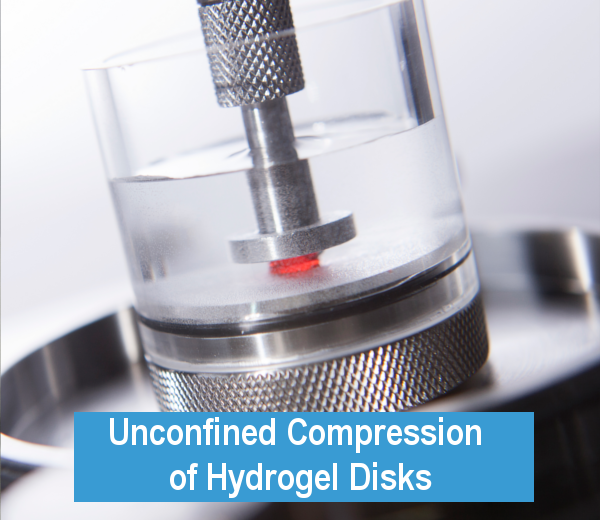
The tablets were tested in a chamber filled with distilled water after 71 ± 3 hours of hydration and swelling in distilled water. The mean thickness (5.44 ± 0.97 mm) and diameter (5.76 ± 0.01 mm) mm of the tablets were measured with a micrometer. Stress relaxation measurements were performed on four types of samples characterized by different compression forces on the powder during the fabrication and dry hardness (See Table 1). During mechanical testing, a first compression step at low velocity is applied to compress the tablet to a uniform thickness. Then, 4 small compression steps of 1% of the thickness are applied at a velocity of 0.2%/s with a relaxation time of 10,000 seconds after each step. This is followed by 4 steps of release using the same conditions.
Table 1 : Physical Characteristics of Fabrication
| Sample | Compressive force on the powder (kN) |
Hardness (N) |
| 1 | 4.17 | 141 |
| 2 | 6.3 | 175 |
| 3 | 10.6 | 198 |
| 4 | 13.6 | 206 |
A typical stress relaxation test curve for Sample 2 is shown. These results show that swollen tablets successfully withstand the imposed loading protocol since they have a nearly reversible behavior with similar equilibrium loads during compression and release. The peak load, however,
is higher during compression compared to release. The equilibrium stiffness of the tablets is also shown to increase with compression. Interestingly, the equilibrium stiffness decreases with compression force applied to the powder during fabrication and with the dry hardness of the tablet.
A creep test was used in this study to observe swelling and the evolution of mechanical properties during swelling. Swelling of Sample 2 in distilled water for 5 hours is shown. A compression ramp of 20 mm at a velocity of 4 mm/s with a relaxation time of 10 s was applied every half hour during swelling. The tablets swelled by 700 um during 5 hours. Furthermore, the mechanical properties are quite different for dry tablets (t=0s) compared to the hydrated tablets. Swelling of the tablet alters its structure so that the dynamic stiffness is reduced by a factor of 3 after 5 hours of hydration and swelling.
Data from mechanical tests can be analyzed to obtain structural information. Using a fibril-network reinforced poroelastic model developed for tissue mechanics, the stress relaxation curves can be processed to obtain four model parameters : matrix equilibrium stiffness (Em), hydraulic permeability (k), matrix Poisson’s ratio (v) and fibril network stiffness (Ef) (refer to Soulhat et al 1999 on this website).
k can be directly related to pore size and thus drug transport of the tablets. Em can be related to the stiffness of the central part of the tablet and Ef to the stiffness of the membrane surface layer. In fact, during swelling, we observed that tablets are characterized by a surface layer with properties different from the central portion. Results were obtained by fitting the stress relaxation curves with the model. Interestingly, Ef is higher and k is smaller in compression than in release. Ef is directly related to the peak load which is lower in release. The increase of k can be explained by the fact that the tablet continues to swell during compression. Microstructural information can be further obtained by using the Navier-Stokes equations to estimate the pore size of the matrix. The resulting pore size of the matrix varies between 5 and 15 nm, increasing during hydration.
In this case study, we have shown that the Mach-1 can precisely measure the mechanical properties of swollen pharmaceutical tablets. Critically important information was obtained showing that the mechanical properties of dry tablets (compression force of the powder and hardness) differed drastically from those of hydrated tablets. Furthermore, we hypothesize that the mechanical behavior of hydrated tablets are more closely related to events controlling the drug release. In fact, we observed that after 71 hours of swelling, the equilibrium stiffness is higher for tablets manufactured with a smaller force of compression on the powder. This may be explained by the presence of defects or cracks in harder tablets manufactured with higher compression forces. Results not shown also indicated that mechanical properties of hydrated tablets are influenced by the salt concentration and pH of the test solution.
Figures

Figure 1 — Afficher la légende
Échantillons de comprimés pharmaceutiques à l’état sec et hydraté.

Figure 2 — Afficher la légende
Évolution de la position et de la force pendant un essai de relaxation par paliers sur un comprimé.

Figure 3 — Afficher la légende
Rigidité à l’équilibre en fonction de la déformation pour des comprimés préparés sous différentes forces de compression de la poudre.

Figure 4 — Afficher la légende
Évolution de la position et de la force pendant un essai de fluage d’un comprimé.

Figure 5 — Afficher la légende
Comparaison de la rigidité et de la perméabilité entre les phases de compression et de relâchement.
Ressources associées (1)
Produits (1)

Accessoires (9)


Configurations de test (2)

Configuration de test
Compression Non-Confinée

Configuration de test
Gonflement et contraction
Matériaux (1)

Matériau