Lachlan James Smith
University of Adelaide. Ph.D. thesis. 2008.
0 citations · 0 en 2025–2026
Les titres, résumés et légendes des publications sont présentés en anglais.
Degeneration of the lumbar intervertebral disc, a condition widely implicated in the cause of low back pain among adult humans, is typically characterised by progressive biochemical and structural changes to the extracellular matrix. Comprehensive descriptions of the structural and functional inter-relationships within the extracellular matrix are therefore critical to understanding the degenerative process and developing effective treatments. In the anulus fibrosus, this matrix has a complex, hierarchical architecture comprised of collagens, proteoglycans, and elastic fibres. Elastic fibres are critical constituents of dynamic biological structures that functionally require elasticity and resilience. Studies to date of elastic fibre network structure in the anulus fibrosus have been qualitative and limited in scope. Additionally, there is poor understanding of the structural and functional associations between elastic fibres and other matrix constituents such as collagen, and, critically, there have been no studies directly examining the nature and magnitude of the contribution made by elastic fibres to anulus fibrosus mechanical behaviour. In this thesis, multiple experimental studies are described that specifically examine each of these areas.
Novel imaging techniques were developed and combined with histochemistry and light microscopy to facilitate the visualisation of elastic fibres at a level of detail not previously achieved. Examination of elastic fibre network structure revealed architectural differences between the intralamellar and interlamellar regions, suggesting that elastic fibres perform functional roles at distinct levels of the anulus fibrosus structural hierarchy. The density of elastic fibres within lamellae was found to be significantly higher in the lamellae of the posterolateral region of the anulus than the anterolateral, and significantly higher in the outer regions than the inner, suggesting it may be commensurate with the magnitude of the tensile strains experienced by each region of the disc in bending and torsion.
The nature of the structure-function associations between elastic fibres and collagen was then examined with respect to the reported structural mechanisms of collagen matrix tensile deformation. Histological assessment of collagen crimp morphology in specimens from which elastic fibres had been enzymatically removed revealed no observable differences when compared with controls, suggesting that any contribution made by elastic fibres to maintaining crimp is minimal. Elastic fibres in anulus fibrosus specimens subjected to radial tensile deformations exhibited complex patterns of re-arrangement, suggesting that they maintain cross-collagen fibre connectivity. Elastic fibres were also observed to maintain physical connections between consecutive lamellae undergoing relative separation.
Finally, the nature and magnitude of the contribution made by elastic fibres to anulus fibrosus mechanical properties at the tissue level was investigated using a combination of biochemically verified enzymatic treatments and biomechanical tests. Targeted degradation of elastic fibres resulted in a significant reduction in both the initial modulus and the ultimate modulus, and a significant increase in the extensibility, of radially oriented anulus fibrosus specimens. Separate treatments and mechanical tests were used to account for any changes attributable to non-specific degradation of glycosaminoglycans. These results suggest that elastic fibres enhance the mechanical integrity of the anulus fibrosus extracellular matrix in the direction perpendicular to the plane containing the collagen fibres.
In summary, the results of the studies presented in this thesis provide important new insights into the structure and function of the anulus fibrosus elastic fibre network, and highlight its potential importance as a contributing or ameliorating factor in the progression of the structural and mechanical changes associated with intervertebral disc degeneration. Additionally, these results establish an improved framework for the development of more accurate analytical and finite element models to describe disc behaviour.
Utilisation des équipements
Un Mach-1 A400.25 mesurait la réponse en traction radiale de l’anneau fibreux lombaire humain avant et après traitement enzymatique. Les échantillons étaient testés dans une solution saline après préconditionnement, avec des rampes quasi statiques à 5 µm/s pour déterminer les modules initial et ultime et l’extensibilité.
Article et documents
Consulter la source
Consulter la source
Consulter la source
Consulter la source
Matériaux (1)
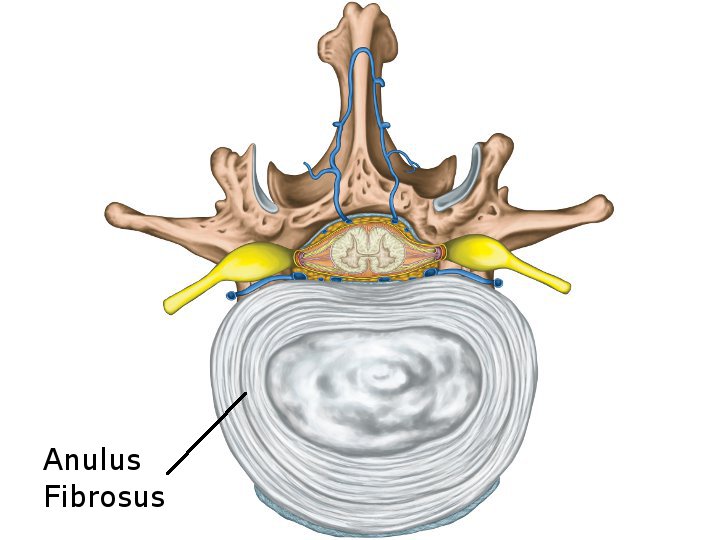
Disque (anneau fibreux)
Configurations de test (1)
