Juran CM; Dolwick MF; McFetridge PS
J Dent Res. 2013 Feb, 92(2):193-8.
https://doi.org/10.1177/0022034512468749
Les titres, résumés et légendes des publications sont présentés en anglais.
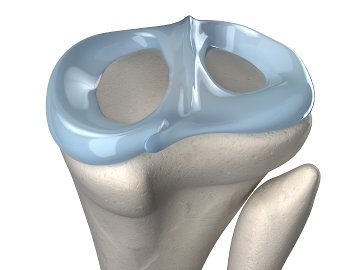
The temporomandibular joint (TMJ) is a complex hinge and gliding joint that induces significant shear loads onto the fibrocartilage TMJ disc during jaw motion. The purpose of this study was to assess regional variation in the disc's shear loading characteristics under physiologically relevant loads and to associate those mechanical findings with common clinical observations of disc fatigue and damage. Porcine TMJ discs were compressed between an axially translating bottom platen and a 2.5-cm-diameter indenter within a hydrated testing chamber. Discs were cyclically sheared at 0.5, 1, or 5 Hz to 1, 3, or 5% shear strain. Within the anterior and intermediate regions of the disc when sheared in the anteroposterior direction, both shear and compressive moduli experienced a significant decrease from instantaneous to steady state, while the posterior region's compressive modulus decreased approximately 5%, and no significant loss of shear modulus was noted. All regions retained their shear modulus within 0.5% of instantaneous values when shear was applied in the mediolateral direction. The results of the disc's regional shear mechanics suggest an observable and predictable link with the common clinical observation that the posterior region of the disc is most often the zone in which fatigue occurs, which may lead to disc damage and perforation.
Utilisation des équipements
Le Mach-1 appliquait un chargement combinant compression et cisaillement cyclique à des échantillons de disque temporomandibulaire dans du PBS.
Article et documents
Document
Consulter dans PubMed
Document
Consulter dans ResearchGate
Matériaux (3)

Configurations de test (2)

Configuration de test
Compression Non-Confinée

Configuration de test