
Test configuration
The lens is a transparent, biconvex structure in the eye that, along with the cornea, helps refract light to be focused on the retina.
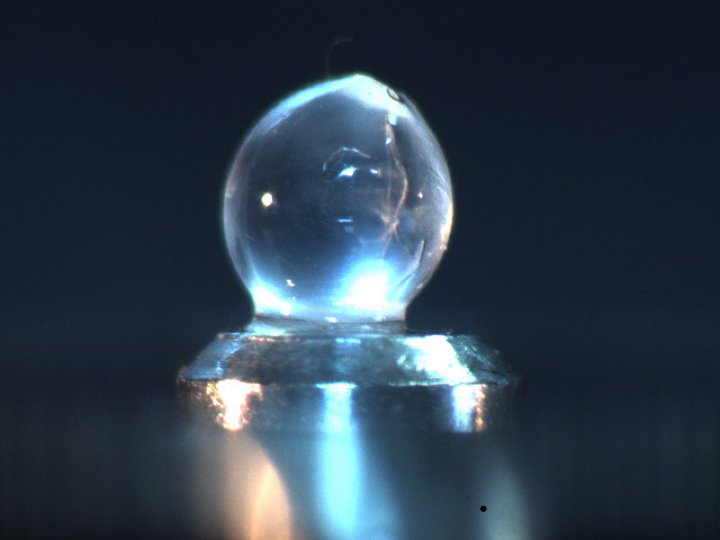
The lens is a transparent, biconvex structure in the eye that, along with the cornea, helps refract light to be focused on the retina. The lens, by changing shape, has the function of modifying the focal distance of the eye so that it can focus on objects at various distances. This allows a sharp real image of the object of interest to be formed on the retina.







This feature is used to obtain the Frequency, Amplitude and Offset of a sinusoidal signal. A blue line displays the theoretical sinusoid with the Frequency, Amplitude and Offset obtained (Figure 1). The values of the Frequency, Amplitude and Offset are indicated in the "Results" field. The units vary according to the graph’s axes.
This feature can also be used for sinusoidal stimulus-response analysis. Sinusoidal stimulus shall be selected on the x-axis and the sinusoidal response on the y-axis. The Modulus is the ratio of the response Amplitude over the stimulus Amplitude. The Phase is the phase difference between the response and the stimulus. The Modulus’ is computed as the Modulus*Cos(Phase) and the Modulus” is computed as the Modulus*Sin(Phase). A blue line displays the theoretical sinusoidal stimulus-response with the Frequency, Modulus and Phase obtained (Figure 2). The values of the Modulus and Phase are indicated in the “Results” field. The units vary according to the graph’s axes.
One use for this feature would be to compute material properties by multiplying the Modulus obtained by the appropriate geometric factors. For example, the Young’s Modulus can be obtained during uniaxial compression or tension on cylindrical sample with t/pi*r2 as the geometric factor, t is the thickness and r is the radius of the sample.
Mach-1 Analysis – Sinusoid – Example for stimulus-response analysis
LAB MODULE – Unconfined Compression of Hydrogel Disks – Student Version
