Meniscus
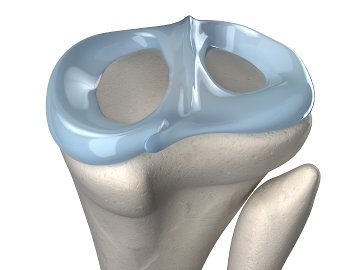
The meniscus is a fibrocartilaginous structure that serves as a shock absorber, lubricator and secondary stabilizer in the knee.
About this material
The meniscus is a fibrocartilaginous structure that serves as a shock absorber, lubricator and secondary stabilizer in the knee. It is shaped like two hemi-circular pieces with a triangular section attached to the tibial plateau. It is characterized by a high water content, structured collagen fiber alignment and some charged macromolecules providing efficient load transfer between the femur and tibia. The meniscus is susceptible to both traumatic injuries and degenerative changes. A meniscus tear is a very common affection of the knee which can be generally treated under arthroscopy. Orthopedic surgeons and researchers are actively working towards improving the current treatment options and are developing meniscus repair products and synthetic meniscal implants, where mechanical testing plays an important role.
Test configurations (19)
Tension
Unconfined Compression
Indentation (Stiffness)
Friction
3D Thickness Mapping
Shear
Impact
Confined Compression

Temperature Control
Positioning (Manual Tilt)
Mechanical Stimulation (Shear)
Mechanical Stimulation (Tension)
Mechanical Stimulation (Compressive)
Puncture
External Analog Sensors
Camera Feed
Positioning (Manual)
Positioning (X Auto)
Case studies (1)
Related resources (4)
Related literature
Biotribology of meniscus degeneration: correlations between frictional, structural and compressive properties
Luisa de Roy; Zeynep Kara; Graciosa Quelhas Teixeira; Benjamin Mayer; Jonas Schwer; Martin Faschingbauer; Anita Ignatius; Andreas Martin Seitz
Frontiers in Bioengineering and Biotechnology. 2026;14:1973631. Published 5 November 2026. DOI: 10.3389/fbioe.2026.1973631
0 citations · 0 in 2025–2026
Effects of Preservation on the Compressive Properties and Microstructure of the Knee Meniscus
Chester Jar; Abbi Oguchi; Mohammadhamed Shahsavari; Nadr M. Jomha; Lindsey Westover; Gail M. Thornton
Ann Biomed Eng (2026), Published: 15 June 2026
0 citations · 0 in 2025–2026
Pneumatospinning and Electrospinning Scaffolds for Meniscus Regeneration Using Human Embryonic-Derived Mesenchymal Stem Cells
Shawn P. Grogan; Erik W. Dorthé; Austin B. Williams; Nicholas E. Glembotski; Darryl D. D’Lima
Bioengineering (Basel, Switzerland). 2026;13(3):314.
1 citation · 1 in 2025–2026
Integrin inhibition facilitates fibrocartilaginous transformation in connective tissue in osteoarthritis
Ruiye Bi; Xianni Yang; Haohan Li; Yanjing Zhan; Qing Yin; Han Fang; Ziqian Wang; Binbin Ying; Haopeng Yu; Songsong Zhu
Science Advances, Vol 12, Issue 1, Published: 2 Jan 2026
4 citations · 4 in 2025–2026
Influence of in vitro test conditions on the Biomechanical properties of degenerated human lateral menisci
Michael Seidenstuecker; Luisa de Roy; Max F. Weiske; O. Piquet; Graciosa Quelhas Teixeira; Hermann O. Mayr; Bianca Riedel; Andreas M. Seitz
J Orthop Surg Res., PMCID: PMC12326754, PMID: 40770642, Published: 2025 Aug 6
1 citation · 1 in 2025–2026
Chitosan/Platelet‐Rich Plasma Implants in an Ovine Arthroscopic Model of Meniscus Repair
Margaux Delvaux; Anik Chevrier; Sotcheadt Sim; Éric Quenneville; Mark B. Hurtig; Gregory De Crescenzo; Marc Lavertu
Journal of Orthopaedic Research 43(10):1875–1886
1 citation · 1 in 2025–2026
Impact of applying traction in indentation tests for estimating axial compressive parameters for computational modeling of sutured meniscal horns
Alejandro Peña-Trabalon; Maria Prado-Novoa; Luisa de Roy; Andreas M. Seitz; Salvador Moreno-Vegas; M. Belen Estebanez Campos; Ana Perez-Blanca
Acta Mech., Volume 42, article number 624717, Published: 04 June 2025
0 citations · 0 in 2025–2026
Changes in Axial Compression Parameters of the Sutured Human Meniscal Horn Subjected to Axial Compression and Circumferential Traction: Experimental–Computational Analysis [English translation]
Alejandro Peña-Trabalon; Maria Prado-Novoa; Luisa de Roy; Andreas M. Seitz; Salvador Moreno-Vegas; M. Belen Estebanez Campos; Ana Perez-Blanca
XVI Congreso Iberoamericano de Ingeniería Mecánica, Concepción, Chile, 22–24 October 2024. Full conference paper, 11 pages. English title is an identified translation of the original Spanish title. Original English abstract. Alternate-title deposit: https://hdl.handle.net/10630/40185. Related journal article in 2025 is a distinct publication.
Compressive relaxation properties of human meniscus increase under combined traction and compression
Alejandro Peña-Trabalon; Luisa de Roy; Ana Perez-Blanca; Maria Prado-Novoa; Andreas Martin Seitz
29th Congress of the European Society of Biomechanics, Edinburgh, Scotland, 30 June–3 July 2024.
Improved Computational Modeling of the Mechanical Behavior of Sutured Human Meniscal Tissue under Combined Loading [English translation]
Alejandro Peña-Trabalon; Maria Prado-Novoa; Salvador Moreno-Vegas; M. Belen Estebanez Campos; Ana Perez-Blanca
XIII Congreso del Capítulo Español de la Sociedad Europea de Biomecánica (ESB), Pamplona, 28–29 October 2024. Original abstract: Spanish (español). English title is an identified translation. Separate communication from the 2024 CIBIM full paper and 2025 journal article.
Mechanical and histological properties of native medial menisci compared to allograph medial menisci in the osteoarthritic knee
Max Weiske; Bianca Riedel; Eva Johanna Kubosch; Hermann O. Mayr; Hagen Schmal; Michael Seidenstuecker
Frontiers in Bioengineering and Biotechnology. 2024;12:1364536.
2 citations · 2 in 2025–2026
Biomechanical and Biochemical Characterization of Menisci and Articular Cartilage in Degenerated Knees [English translation]
Biomechanische und biochemische Charakterisierung von Menisken und Gelenkknorpel degenerierter Knie. Thesis, 2023. DOI: 10.18725/oparu-49387 Original German title: Biomechanische und biochemische Charakterisierung von Menisken und Gelenkknorpel degenerierter Knie. The displayed English title is an identified translation. The complete original German summary is retained.
Chitosan/platelet-rich plasma implants in a large arthroscopic model of meniscus repair
Margaux Delvaux; Anik Chevrier; Sotcheadt Sim; Éric Quenneville; Gregory De Crescenzo; Marc Lavertu
Communication CCTC
On the fractional transversely isotropic functionally graded nature of soft biological tissues: Application to the meniscal tissue
Sachin Gunda; Sundararajan Natarajan; Olga Barrera
Journal of the Mechanical Behavior of Biomedical Materials, Volume 143, 2023, 105855, ISSN 1751-6161, Published: 6 May 2023
6 citations · 3 in 2025–2026
Biomechanical proprieties of the meniscus in knee osteoarthritis: experimental tests and constitutive model [English translation]
Università degli Studi di Padova. Thesis. Academic year 2022/2023. Repository citation year: 2022. Original abstract: English.
Anisotropy and inhomogeneity of permeability and fibrous network response in the pars intermedia of the human lateral meniscus
Matteo Berni; Gregorio Marchiori; Giorgio Cassiolas; Alberto Grassi; Stefano Zaffagnini; Milena Fini; Nicola Francesco Lopomo; Melania Maglio
Acta Biomaterialia Volume 135, November 2021, Pages 393-402
17 citations · 9 in 2025–2026
Osteoarthritis-Related Degeneration Alters the Biomechanical Properties of Human Menisci Before the Articular Cartilage
Andreas M. Seitz; Felix Osthaus; Jonas Schwer; Daniela Warnecke; Martin Faschingbauer; Mirco Sgroi; Anita Ignatius; Lutz Dürselen
Front Bioeng Biotechnol. 2021 May 6;9:659989. doi: 10.3389/fbioe.2021.659989. PMID: 34026741; PMCID: PMC8134692.
60 citations · 18 in 2025–2026
The Human Meniscus Behaves as a Functionally Graded Fractional Porous Medium under Confined Compression Conditions
Raphaël Bulle; Gioacchino Alotta; Gregorio Marchiori; Matteo Berni; Nicola F. Lopomo; Stefano Zaffagnini; Stéphane P. A. Bordas; Olga Barrera
Appl. Sci. 2021, 11, 9405. https://doi.org/10.3390/app11209405
18 citations · 3 in 2025–2026
Analysis of Proteoglycan Content and Biomechanical Properties in Arthritic and Arthritis-Free Menisci
Johannes Pordzik; Anke Bernstein; Hermann O. Mayr; Sergio H. Latorre; Anastasija Maks; Hagen Schmal; Michael Seidenstuecker
December 2020Applied Sciences 10(24):9012 DOI: 10.3390/app10249012
9 citations · 4 in 2025–2026
Correlation of Biomechanical Alterations under Gonarthritis between Overlying Menisci and Articular Cartilage2
Johannes Pordzik; Anke Bernstein; Julius Watrinet; Hermann O. Mayr; Sergio H. Latorre; Hagen Schmal; Michael Seidenstuecker
Appl. Sci. 2020, 10, 8673. https://doi.org/10.3390/app10238673
11 citations · 3 in 2025–2026
Ultrashort Time to Echo Magnetic Resonance Evaluation of Calcium Pyrophosphate Crystal Deposition in Human Menisci
Tim Finkenstaedt; Reni Biswas; Nirusha A. Abeydeera; Palanan Siriwanarangsun; Robert Healey; Sheronda Statum; Won C. Bae; Christine B. Chung
Invest Radiol. 2019 Jun. 54(6):349-355.
21 citations · 4 in 2025–2026
Freeze-Dried Chitosan-PRP Injectable Surgical Implants for Meniscus Repair: Pilot Feasibility Studies in Ovine Models
Ghazi Zadeh L; Chevrier A; Hurtig MB; Farr J; Rodeo S; Buschmann MD; Hoemann CD
Regen Med Ther, 1(1) 16-29. (2017)
10 citations · 5 in 2025–2026
Freeze-dried chitosan-PRP implants improve meniscus repair in an ovine model
Ghazi Zadeh L; Chevrier A; Hurtig M; Farr J; Rodeo S; Hoemann C; Buschmann M
International Cartilage Repair Society (ICRS), Sorrento, 2016, Poster P112
Thickness of the Meniscal Lamellar Layer: Correlation with Indentation Stiffness and Comparison of Normal and Abnormally Thick Layers by Using Multiparametric Ultrashort Echo Time MR Imaging
Ja-Young Choi; Reni Biswas; Won C. Bae; Robert Healey; Michael Im; Sheronda Statum; Eric Y. Chang; Jiang Du; Graeme M. Bydder; Darryl D’Lima; Christine B. Chung
Radiology. 2016;280(1)
15 citations · 1 in 2025–2026
Micro-CT visualization and indentation properties of whole meniscus following mercury exposure
Kolaczek S; Changoor A; Hurtig M; Gordon K; Getgood A
Annual Meeting of the ORS, New Orleans, Louisiana, USA, March 15-18, 2014.
Shear mechanics of the TMJ disc - relationship to common clinical observations
Juran CM; Dolwick MF; McFetridge PS
J Dent Res. 2013 Feb, 92(2):193-8.
A fibril-network-reinforced biphasic model of cartilage in unconfined compression
J. Soulhat; M. D. Buschmann; A. Shirazi-Adl
Journal of Biomechanical Engineering, Jun, 121(3), 340-347. (1999)
250 citations · 9 in 2025–2026
FAQ
What is Poroelasticity?+
Mach-1 Analysis – Poroelastic Model in Unconfined Compression – Parameters
Mach-1 Analysis – Poroelastic Model in Confined Compression – Parameters
Mach-1 Analysis – Poroelastic Model in Confined Compression – Example
Mach-1 Analysis – Poroelastic Model in Unconfined Compression – Cartilage
Mach-1 Analysis – Poroelastic Model in Unconfined Compression – Example
LAB MODULE – Torsion of Disk-Shaped Samples – Student Version
How does the "Poroelastic Model in Confined Compression" feature works?+
This model is well adapted for the mechanical characterization of samples containing a liquid fraction and a solid matrix, for example: cartilage or gel samples. A user license is required in order to obtain the results of the poroelastic model in confined compression (Software Add-On, contact Biomomentum to obtain your license).
Mechanical properties can be obtained from the stress relaxation curves obtained under confined compression such as the aggregate modulus (HA) and the hydraulic permeability (k). The aggregate modulus is a measure of stiffness of the sample at equilibrium while the hydraulic permeability is the ability of the fluid to flow through the cartilage matrix.
For example, (Figure 2) shows parameters used for the “Stress Relaxation” function in a confined compression testing protocol on human cartilage disks. Corresponding results are shown in (Figure 1).
Mach-1 Analysis – Poroelastic Model in Confined Compression – Parameters
Mach-1 Analysis – Poroelastic Model in Confined Compression – Example
How does the "Poroelastic Model in Unconfined Compression" feature works?+
The nonhomogeneous composite model (i.e. linear fibril-network-reinforced biphasic model) is an extension of the previously developed isotropic homogeneous biphasic model, and was achieved by reinforcing the latter with a network of nonlinear fibrils distributed homogeneously in the r, θ, z directions and which resist extension only (Figure 2). The isotropic matrix is described by the drained elastic constants Em (Young’s modulus), vm (Poisson’s ratio) and a hydraulic permeability k. The fibril network is described by the Young’s modulus of individual fibrils ef which, combined with a fibril volume fraction χ (fibrils volume/ total-volume), results in an equivalent tensile modulus of the fibril network, Ef = 1/3 χ ef (since 1/3 of the fibrils are oriented in each of three mutually orthogonal directions).
For example, (Figure 3) shows parameters used for the “Stress Relaxation” function in an unconfined compression testing protocol on ovine cartilage disks. Corresponding results are shown in (Figure 1).
Mach-1 Analysis – Poroelastic Model in Unconfined Compression – Parameters
Mach-1 Analysis – Poroelastic Model in Unconfined Compression – Cartilage
Mach-1 Analysis – Poroelastic Model in Unconfined Compression – Example
How does the "Sinusoid" model works?+
This feature is used to obtain the Frequency, Amplitude and Offset of a sinusoidal signal. A blue line displays the theoretical sinusoid with the Frequency, Amplitude and Offset obtained (Figure 1). The values of the Frequency, Amplitude and Offset are indicated in the "Results" field. The units vary according to the graph’s axes.
This feature can also be used for sinusoidal stimulus-response analysis. Sinusoidal stimulus shall be selected on the x-axis and the sinusoidal response on the y-axis. The Modulus is the ratio of the response Amplitude over the stimulus Amplitude. The Phase is the phase difference between the response and the stimulus. The Modulus’ is computed as the Modulus*Cos(Phase) and the Modulus” is computed as the Modulus*Sin(Phase). A blue line displays the theoretical sinusoidal stimulus-response with the Frequency, Modulus and Phase obtained (Figure 2). The values of the Modulus and Phase are indicated in the “Results” field. The units vary according to the graph’s axes.
One use for this feature would be to compute material properties by multiplying the Modulus obtained by the appropriate geometric factors. For example, the Young’s Modulus can be obtained during uniaxial compression or tension on cylindrical sample with t/pi*r2 as the geometric factor, t is the thickness and r is the radius of the sample.
Mach-1 Analysis – Sinusoid – Example for stimulus-response analysis