D. Acton; A. Perry; R. Evans; A. Butler; P. Stephens; W. Bruce; J. Goldberg; D. Sonnabend; W. R. Walsh
Knee Surgery, Sports Traumatology, Arthroscopy, 2004, 12(2), 165-168
https://doi.org/10.1007/s00167-003-0399-y
12 citations · 0 en 2025–2026
Les titres, résumés et légendes des publications sont présentés en anglais.
An understanding of the mechanical properties of different suture materials is valuable when selecting the most appropriate suture and repair technique. Sutures should be strong, easy to handle and have high knot security. The introduction of suture anchors adds an additional variable regarding the effect of stress risers over the eyelet. Improving the mechanical properties of a suture may be a possible method to help avoid failure over stress risers such as the eyelet of suture anchor. This study examined the static and viscoelastic properties of a new polyethylene based non-resorbable suture (Fibrewire) over the eyelet of a standard anchor compared to braid polyester non-resorbable suture (Ethibond). Fibrewire had superior ultimate load properties compared to Ethibond (360.2 N+/-23.8 vs 191.9 N+/-17.3) as well as greater stiffness (61.3 N/mm+/-9.7 vs 8.1 N/mm+/-0.4) when tested in uniaxial tension through a metal anchor eyelet (Mitek) (p<0.001). Fibrewire demonstrated greater stress relaxation than Ethibond (p<0.05). Differences in the static and viscoelastic properties of suture may have implications in the post-operative period or during rehabilitation.
Utilisation des équipements
Le Mach-1 mesurait la rigidité et la relaxation des contraintes des fils Ethibond et Fibrewire dans du PBS à 37 °C. Les essais de rupture sur l’ancre utilisaient un système MTS.
Article et documents
Document
Consulter dans ResearchGate
Matériaux (1)
Matériau
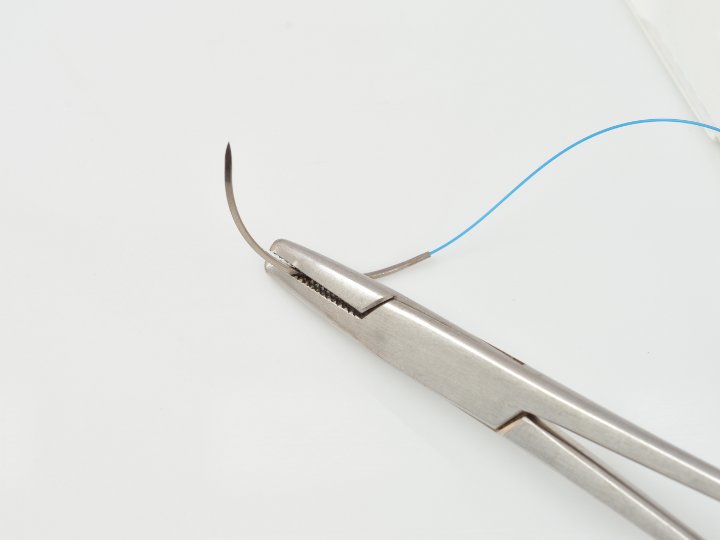
Materiau de suture
Configurations de test (2)

Configuration de test
Tension
Configuration de test