Frank Vizesi; Chris Jones; Nick Lotz; Mark Gianoutsos; William R. Walsh
The Journal of Hand Surgery. 2008.
https://doi.org/10.1016/j.jhsa.2007.10.011
48 citations · 2 en 2025–2026
Les titres, résumés et légendes des publications sont présentés en anglais.
PURPOSE: The time-dependent mechanical behavior of common suture materials may have a pronounced influence on the quality of flexor tendon repairs with respect to gap formation.
METHODS: Sutures commonly used in plastic surgery, particularly for hand tendon repair, were tested in tension for analysis of stress relaxation and creep properties. The three materials tested were (1) Prolene, a monofilament polypropylene(Ethicon, Somerville, NJ); (2) Ethilon, a monofilament nylon(Ethicon, Somerville, NJ); and (3) Ticron, a braided polyester fiber (Sherwood, Davis & Geck, St. Louis, MO). All measurements were made with 1.5-mm (4-0) varieties of the sutures, in physiological buffered solution (0.9% phosphate-buffered saline [PBS]) at both room (22 degrees C) and body temperature (37 degrees C) conditions.
RESULTS: Ticron was the stiffest suture at both room and body temperature, followed by Prolene and Ethilon. Both Prolene and Ethilon showed statistically (p< .05) reduced stiffness at body temperature. Prolene exhibited statistically larger (p< .05) relaxation and creep ratios than the other two sutures, and it was the only material to show temperature effects in creep and relaxation.
CONCLUSIONS: Based on static and viscoelastic mechanical properties, Ticron is the most suitable suture for flexor tendon repairs when compared to Prolene and Ethilon.
Utilisation des équipements
Un Mach-1 mesurait la relaxation et le fluage en traction de sutures Prolene, Ethilon et Ticron dans du PBS, à température ambiante ou 37 °C. La relaxation maintenait la déformation; le fluage maintenait la force.
Matériaux (1)
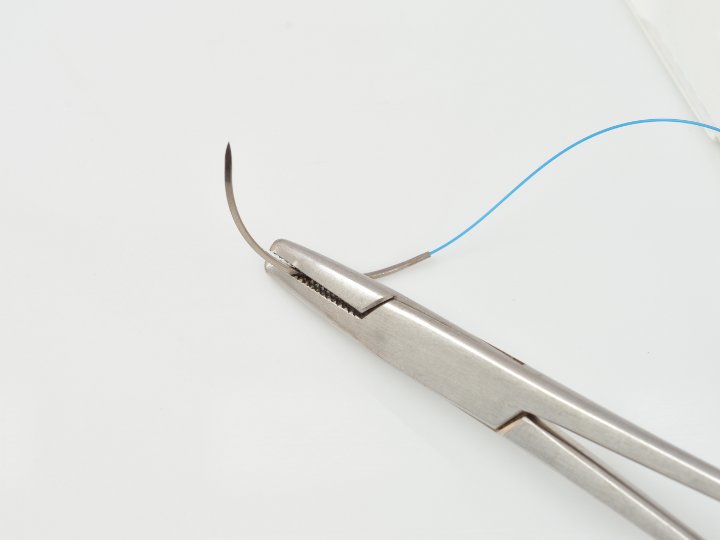
Materiau de suture
Configurations de test (2)
