E. Wright; W. R. Walsh; P. Stephens; R. Evans; Y. Yu; P. Hughes; J. D. Acton; A. Perry; W. Bruce
50th Annual Meeting of the Orthopaedic Research Society. 2004; poster 1234.
Les titres, résumés et légendes des publications sont présentés en anglais.
INTRODUCTION: The complex vascularity anatomy of the meniscus1,2 has been implicated in poor healing of tears present in the “red-white” or “white-white” zone.3,4 Partial removal of the meniscus alters the load distribution in the knee with strong evidence of development of arthritic changes. Even with advances in arthroscopic repair of meniscal tears, insufficient healing and angiogenic response following injury or repair continues to be a limiting factor in the meniscus. The use of single exogenous growth factors or other biologic enhancement techniques have reported mixed results.4-6 Butryic acid (BA) which is a four-carbon fatty acid also known as butanoic acid is a recognised angiogenic factor. The potential of an exogenous factor incorporated into sutures to improve healing of meniscal tears is clinically significant. This study determined the release kinetics of a suture impregnated with BA and the histology and mechanical properties resulting from its use in the repair of red-white meniscal tears in an adult sheep model.
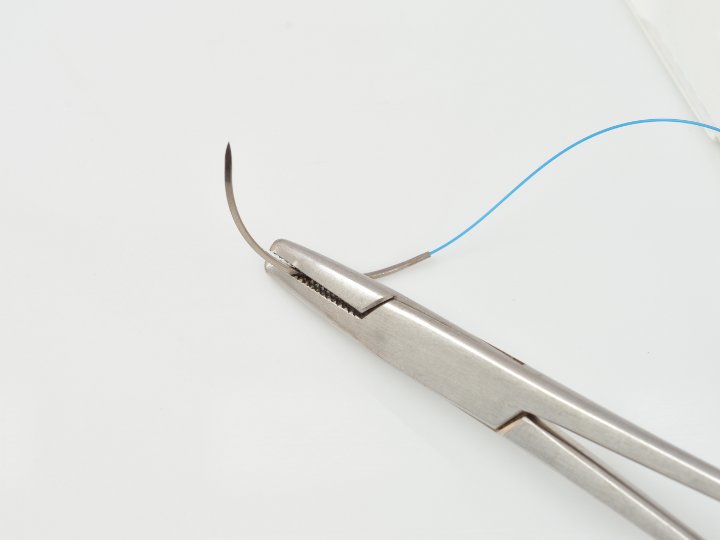
METHODS: The release rate of BA into an aqueous environment from silicon coated sutures (0 Ticron) treated with BA for different times was measured in vitro out to 28 days using high phase liquid chromatography (HPLC) in distilled water (DW) and phosphate buffered saline (PBS). The tensile properties of the suture following treatment with BA was compared with control sutures using a Mach-1 Micromechanical Testing Machine (Biosyntech, Montreal, Canada). The in-vitro experiments were used to determine the appropriate BA treatment time for the sutures for in-vivo performance of the BA treated sutures on meniscal tears. A bilateral medial meniscal tear model in 26 adult crossbred sheep was used following institutional ethical approval. An 8 mm full thickness tear was created in the red-white zone in the circumferential direction in the anteromedial menisci using a #10 blade. The tears were fixed using the 0 Ticron (left sides) or the BA treated 0 Ticron. Gross dissection was performed at the time of sacrifice. The joint was inspected for any gross changes to the articular surfaces of the distal femur or proximal tibia. The gross appearance and degree of healing of the tear was assessed based on a qualitative grading scale combined with manual palpation of the lesion. Animals were killed at 1, 3 and 6 weeks for histology (n = 11) and at 6 weeks for mechanical testing (n = 15). The menisci were tested in uniaxial tension using an MTS 858 Bionix testing machine (MTS, MN) as reported by Bellemans.8 The ultimate load and failure site were recorded for all samples. Data was analyzed using a paired Student’s t-test. Dedicated histology animals were processed for local reaction to the suture for evidence of an inflammatory reaction, neoangiogenesis, new repair tissue and immunohistochemistry for protein expression of VEGF. Serial sections through the tear site were examined. Histology was evaluated in a blinded fashion and analysed using non-parametric statistics. Additional menisci from age-matched sheep, which had not been operated on, were used to examine normal meniscal histology.
RESULTS: In vitro studies revealed BA treatment time of the suture influenced the uptake and subsequent release profile of BA into solution. However the nature of the aqueous solution had no effect on the release profile (Figure 1). A treatment time of 4 weeks was determined to provide appropriate release kinetics of BA to have a therapeutic effect. Treatment of the suture with BA had no deleterious effects on the tensile mechanical properties compared to untreated sutures. No adverse events were encountered in the in-vivo portion of this study. All animals recovered uneventfully following surgery and were weight bearing within 1 hour following recovery from anaesthesia. Gross dissection did not reveal any joint effusion or adverse effects in the control or BA treated suture joints. Macroscopic grading of healing revealed a progression with time for both suture types. Macroscopic evaluation of tear site with BA treated sutures appeared superior to control sutures at 3 weeks, but was only significant at 6 weeks (p<0.05), perhaps due to small sample sizes at earlier time points. Histology revealed some evidence of healing in the control suture group versus time. In contrast, tears repaired with BA treated sutures demonstrated marked histologic differences including new repair tissue at the repair site as well as neoangiogenesis at the repair site, the red zone and even further into the red-white zone. New blood vessels within the BA suture itself were noted at all time points. Mechanical testing of the menisci demonstrated a significantly increase in strength (p<0.05) (Figure 2) and stiffness (p<0.05) in the tears fixed with the BA treated sutures compared to control. All specimens failed at the repair site during mechanical testing.
DISCUSSION: Limitations in the native vascularity of the meniscus may play an important role in the poor healing of tears in the red-white and white-white zones. Release kinetic experiments demonstrated BA could be released over a number of days and play a role in the healing process. The tensile strength and stiffness of red-white tears fixed with a suture treated with butyric acid were improved compared to controls. Histology revealed new repair tissue as well as a generalized angiogenic response in the BA treated group. Interestingly, new repair tissue and new vascularity was observed distal to the repair reaching nearly into the white zone of the meniscus. The use of BA in connective tissue healing is promising.
Utilisation des équipements
Le Mach-1 mesure les propriétés en traction de sutures Ticron témoins et traitées à l’acide butyrique. Les ménisques ovins réparés sont testés séparément sur un MTS 858 Bionix.
Article et documents
Consulter le document (PDF)
Matériaux (1)
Materiau de suture
Configurations de test (1)
