Ghazi Zadeh L; Chevrier A; Hurtig M; Farr J; Rodeo S; Hoemann C; Buschmann M
International Cartilage Repair Society (ICRS), Sorrento, 2016, Poster P112
Les titres, résumés et légendes des publications sont présentés en anglais.
Purpose: Menisci are structurally complex and play an essential weight-‐bearing role in the knee joint. Although there has been a recent increase in the number of meniscus repairs performed yearly in the US [1], only a small number of all meniscal tears are repairable so that current surgical treatment of meniscal tears often involves partial meniscectomy which increases the risk of developing osteoarthritis (OA) [2]. Trephination and meniscus wrapping techniques have had some success in pre-‐clinical models [3] and in clinical studies [4] to augment the rate of healing for complex tears [5]. We have developed a freeze-‐dried chitosan polymer that can be resuspended in PRP to produce a homogeneous mixture that coagulates once implanted and sustains recruitment of host cells to the site. The purpose of this study was to investigate whether healing of ovine meniscus tears can be repaired by applying chitosan-‐PRP implants and/or wrapping the meniscus with a collagen membrane. Electromechanical properties of the tibial plateau and the distal femurs were mapped across the articular surfaces using the Arthro-BST device. The average quantitative parameters (QP) calculated for the medial femoral condyles and for the tibial plateau were similar in all treatment groups and in the contralateral intact menisci, suggesting the surgically induced meniscus tear does not cause severe cartilage degeneration within 6 weeks. Chitosan-‐PRP implants showed evidence of a superior regenerative effect compared to wrapping the meniscus with a collagen membrane. Using the wrap in conjunction with chitosan-‐PRP implants did not further improve repair and the additional sutures needed to secure the wrap created significant damage to the menisci. This suggests that chitosan-‐PRP implants by themselves could be sufficient in overcoming the current limitations of meniscus repair. Further study is certainly required before we would recommend using this clinically.
Utilisation des équipements
Arthro-BST a servi à cartographier les propriétés électromécaniques des surfaces articulaires du plateau tibial et des fémurs distaux dans une étude de réparation méniscale chez le mouton. Les valeurs moyennes du paramètre quantitatif QP ont servi à évaluer le cartilage articulaire entre groupes de traitement et témoins controlatéraux. Le rôle documenté de l’appareil concerne le cartilage, et non des essais mécaniques directs sur les ménisques ou les implants de chitosane–PRP.
Article et documents
Document
Consulter l’affiche (PDF)
Document
Programme de conférence
Matériaux (2)

Matériau
Cartilage articulaire
Matériau
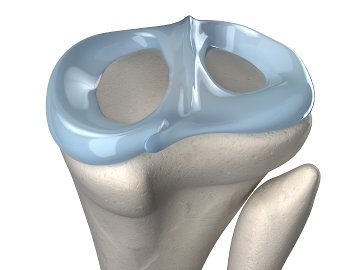
Ménisque
Configurations de test (1)

Configuration de test
Mesure électromécanique
Produits (1)
