T.A. Schmidt; R.L. Sah
Osteoarthritis Cartilage. 2007 Jan;15(1):35-47. Epub 2006 Jul 21
https://doi.org/10.1016/j.joca.2006.06.005
208 citations · 13 en 2025–2026
Les titres, résumés et légendes des publications sont présentés en anglais.
OBJECTIVES: The lubrication of articulating cartilage surfaces in joints occurs through several distinct modes. In the boundary mode of lubrication, load is supported by surface-to-surface contact, a feature that makes this mode particularly important for maintenance of the normally pristine articular surface. A boundary mode of lubrication is indicated by a kinetic friction coefficient being invariant with factors that influence formation of a fluid film, including sliding velocity and axial load. The objectives of this study were to (1) implement and extend an in vitro articular cartilage-on-cartilage lubrication test to elucidate the dependence of the friction properties on sliding velocity, axial load, and time, and establish conditions where a boundary mode of lubrication is dominant, and (2) determine the effects of synovial fluid (SF) on boundary lubrication using this test.
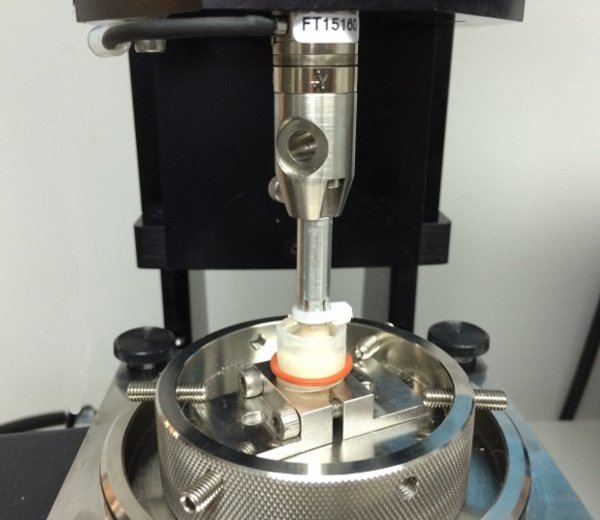
METHODS: Fresh bovine osteochondral samples were analyzed in an annulus-on-disk rotational configuration, maintaining apposed articular surfaces in contact, to determine static (mu(static) and mu(static),(N(eq)) and kinetic ([mu(kinetic)] and [mu(kinetic),(N(eq))]) friction coefficients, each normalized to the instantaneous and equilibrium (N(eq)) normal loads, respectively.
RESULTS: With increasing pre-sliding durations, mu(static) and mu(static),(N(eq)) were similar, and increased up to 0.43 +/- 0.03 in phosphate buffered saline (PBS) and 0.19 +/- 0.01 in SF, whereas [mu(kinetic)] and [mu(kinetic),(N(eq))] were steady. Over a range of sliding velocities of 0.1-1 mm/s and compression levels of 18% and 24%, [mu(kinetic)] was 0.072 +/- 0.010 in PBS and 0.014 +/- 0.003 in SF, and [mu(kinetic),(N(eq))] was 0.093 +/- 0.005 in PBS and 0.018 +/- 0.002 in SF.
CONCLUSIONS: A boundary mode of lubrication was achieved in a cartilage-on-cartilage test configuration. SF functioned as an effective friction-lowering boundary lubricant for native articular cartilage surfaces.
Utilisation des équipements
Des échantillons ostéochondraux bovins frais ont été testés dans une configuration rotationnelle anneau sur disque, avec les surfaces cartilagineuses opposées en contact. Les coefficients de frottement statique et cinétique ont été mesurés pour étudier la lubrification limite et l’effet du liquide synovial. Le résumé disponible précise la géométrie de contact, mais pas l’instrument d’essai ni un rôle du Mach-1 Mechanical Tester.
Article et documents
Document
Consulter dans PubMed
Matériaux (1)

Matériau
Cartilage articulaire
Configurations de test (1)

Configuration de test