Renée S. Suen; Sarah N. Rampersad; Duncan J. Stewart; David W. Courtman
The American journal of pathology, 179(3), 1549-1559. (2011)
https://doi.org/10.1016/j.ajpath.2011.05.014
18 citations · 2 en 2025–2026
Les titres, résumés et légendes des publications sont présentés en anglais.
Because both endothelin-1 (ET-1) and angiotensin II (AngII) are independent mediators of arterial remodeling, we sought to determine the role of ET receptor inhibition in AngII-accelerated atherosclerosis and aortic aneurysm formation. We administered saline or AngII and/or bosentan, an endothelin receptor antagonist (ERA) for 7, 14, or 28 days to 6-week- and 6-month-old apolipoprotein E-knockout mice. AngII treatment increased aortic atherosclerosis, which was reduced by ERA. ET-1 immunostaining was localized to macrophage-rich regions in aneurysmal vessels. ERA did not prevent AngII-induced aneurysm formation but instead may have increased aneurysm incidence. In AngII-treated animals with aneurysms, ERA had a profound effect on the non-aneurysmal thoracic aorta via increasing wall thickness, collagen/elastin ratio, wall stiffness, and viscous responses. These observations were confirmed in acute in vitro collagen sheet production models in which ERA inhibited AngII's dose-dependent effect on collagen type 1 α 1 (COL1A1) gene transcription. However, chronic treatment reduced matrix metalloproteinase 2 mRNA expression but enhanced COL3A1, tissue inhibitor of metalloproteinase 1 (TIMP-1), and TIMP-2 mRNA expressions. These data confirm a role for the ET system in AngII accelerated atherosclerosis but suggest that ERA therapy is not protective against the formation of AngII-induced aneurysms and can paradoxically stimulate a chronic arterial matrix remodeling response.
Utilisation des équipements
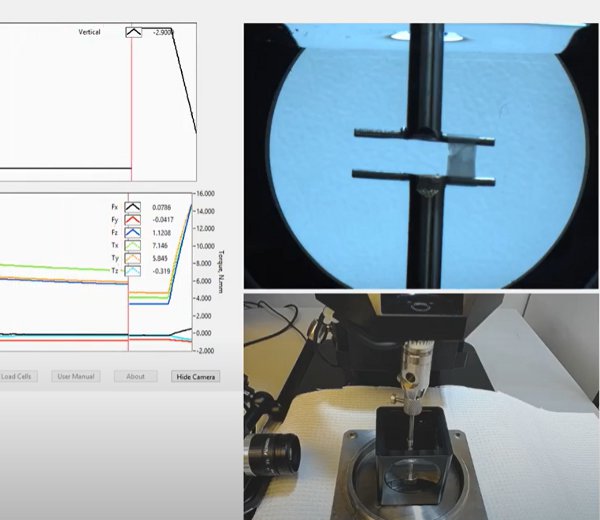
Le Mach-1 étirait des anneaux aortiques murins et mesurait leur relaxation des contraintes dans un bain de Krebs à température contrôlée.
Article et documents
Document
Consulter dans PubMed Central
Matériaux (1)

Matériau
Vasculaire (veine and artère)
Configurations de test (2)

Configuration de test
Tension
Configuration de test
Relaxation des contraintes
Études de cas (1)
Étude de cas