Anahita Gheisari; Aapo Ristaniemi; Mehrnoush Haghighatnejad; Ali Mohammadi; Andrew Sawatsky; Simo Saarakkala; Walter Herzog; Rami K. Korhonen; Mikko A.J. Finnilä
Journal of Biomechanics, Volume 176, 2024, 112350, ISSN 0021-9290
https://doi.org/10.1016/j.jbiomech.2024.112350
4 citations · 4 en 2025–2026
Les titres, résumés et légendes des publications sont présentés en anglais.
Abstract
Anterior cruciate ligament (ACL) injury is a common knee ligament injury among young, active adults; however, little is known about its impact on the viscoelastic properties of the knee joint’s collateral ligaments. This study aimed to characterize and compare the viscoelastic properties of rabbit collateral ligaments in healthy control knees, injured knees, and knees contralateral to the injured knees. Unilateral anterior cruciate ligament transection was performed on six New Zealand white rabbits to create an ACL injury model. Medial and lateral collateral ligaments (MCL and LCL) were collected from the injured and contralateral knees eight weeks after ACL transection. Ligaments were also harvested from both knees of four unoperated rabbits. The ligaments underwent tensile stress-relaxation testing at strain levels of 2, 4, 6, and 8 %, and a sinusoidal loading test at 8 % strain with 0.5 % strain amplitude using frequencies of 0.01, 0.05, 0.1, 0.5, 1, and 2 Hz. The results showed that collateral ligaments of ACL-transected knees relaxed slower compared to control knees. Sinusoidal testing revealed that contralateral knee LCLs had significantly higher storage and loss modulus across all test frequencies. The results indicate that contralateral knee LCLs become stiffer compared to LCLs from control and ACL-transected knees, while LCLs from ACL-transected knees become less viscous compared to LCLs from control and contralateral knees. This study suggests that knee ligaments undergo adaptations following an ACL injury that may affect the mechanics of the ACL-transected knee, which should be considered in biomechanical and rehabilitation studies of patients with an ACL injury.
Keywords
Knee joint; Ligament; Stress-relaxation test; Dynamic mechanical loading test; ACL injury.
Utilisation des équipements
Le Mach-1 Mechanical Tester a mesuré la réponse viscoélastique en traction des ligaments collatéraux médiaux et latéraux de lapin par relaxation des contraintes par paliers et chargement sinusoïdal. Des mors sur mesure maintenaient les ligaments dans un bain de PBS. Les essais comparaient les genoux avec section du LCA, les genoux controlatéraux et les témoins sains.
Matériaux (1)
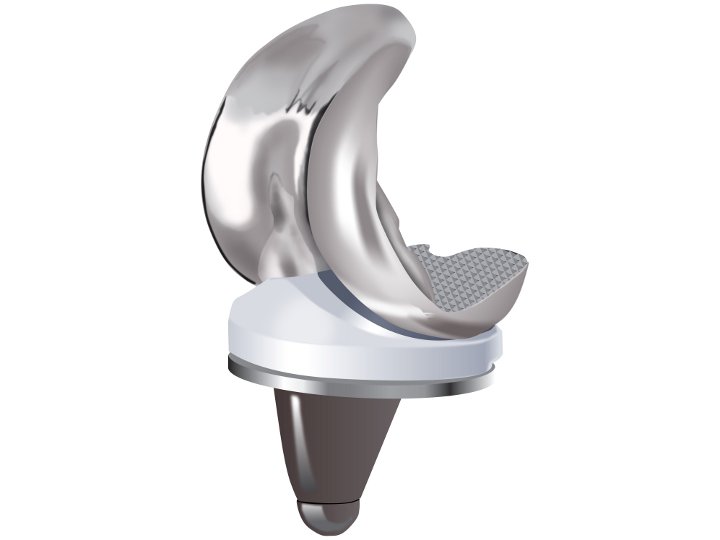
Prothèse (genou)
Configurations de test (3)

Tension
Relaxation des contraintes
