Tissue testing · 0:12
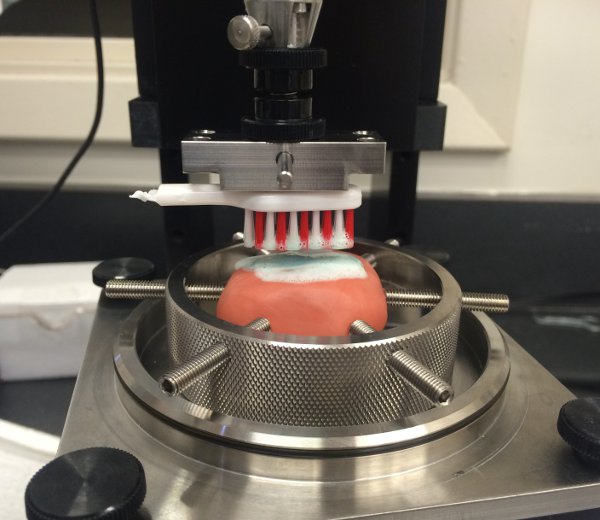
Toothpaste testing in a brushing simulator
A demonstration of toothpaste testing in a tooth brushing simulator.
The shear stimulation of mechanically-responsive cell constructs has been demonstrated to have important effects on the cell's activity, in particular, over the production of extracellular matrix components. This mechanical stimulation is normally performed during cell culture. Biomomentum's mechanical tester can be installed in a standard incubator in dry mode condition. Closed testing chambers have been designed for this particular application. Humidity and gas level are controlled directly inside the chamber made of material compatible with cell culture.
Tissue testing · 0:12
A demonstration of toothpaste testing in a tooth brushing simulator.

Yuri F Hudak; Jing-Sheng Li; Scott Cullum; Brian M Strzelecki; Chris Richburg; G Eli Kaufman; Daniel Abrahamson; Jeffrey T. Heckman; Beth Ripley; Scott Telfer; William R Ledoux; Brittney C Muir; Patrick M Aubin
Medical Engineering & Physics, Volume 104, 2022, 103802, ISSN 1350-4533, https://doi.org/10.1016/j.medengphy.2022.103802.
53 citations · 33 in 2025–2026
PhD Thesis, 2021. Vancouver : University of British Columbia Library
Kabilan Sakthivel; Hitendra Kumar; Mohamed G. A. Mohamed; Bahram Talebjedi; Justin Shim; Homayoun Najjaran; Mina Hoorfar; Keekyoung Kim
Small 2020, 2000941. https://doi.org/10.1002/smll.202000941
27 citations · 7 in 2025–2026
Xudong Deng; Rana Attalla; Lukas P. Sadowski; Mengsu Chen; Michael J. Majcher; Ivan Urosev; Da-Chuan Yin; P. Ravi Selvaganapathy; Carlos D. M. Filipe; Todd Hoare
Biomacromolecules 2018 19 (1), 62-70 doi: 10.1021/acs.biomac.7b01243
31 citations · 4 in 2025–2026
Joanna F. Weber; Loraine L.Y. Chiu; Stefan Balko; Stephen D. Waldman
Weber, J.F., Chiu, L.L., Balko, S. et al. Ann Biomed Eng (2018). https://doi.org/10.1007/s10439-018-02123-x
17 citations · 3 in 2025–2026
Hsu FH; Alonso E; Raleigh AR; Saleh AA; Masuda K; Lotz MK; Chen AC; Sah R
Orthopeadic Research Society Annual Meeting, 2016, Orlando, USA, Poster abstract 1428
Ye Hong; Yifei Yao; Singwan Wong; Liming Bian; Arthur F.T. Mak
Journal of biomechanics, 49(8), 1305-1310. (2016)
12 citations · 2 in 2025–2026
Christoph Meinert; Karsten Schrobback; Peter A. Levett; Cameron Lutton; Robert L. Sah; Travis J. Klein
Acta biomaterialia, October 2016. DOI: 10.1016/j.actbio.2016.10.011
22 citations · 2 in 2025–2026
Hsu FH; Hui AY; Chen AC; Lotz MK; Sah R
Orthopeadic Research Society Annual Meeting in Las Vegas, Abstract 0256
Joanna F. Weber; Stephen D. Waldman
Journal of Orthopaedic Research 08/2015; DOI:10.1002/jor.23000
25 citations · 0 in 2025–2026
Orthopeadic Research Society Annual Meeting in Las Vegas, Abstract 1244
Juran CM; Dolwick MF; McFetridge PS
J Dent Res. 2013 Feb, 92(2):193-8.
Thesis, Queen’s University, 2012.
0 citations · 0 in 2025–2026
Department of Mechanical and Materials Engineering, Department of Chemical Engineering, Queen's University, Kingston, Ontario, Canada; SD Waldman; DC Couto; MD Grynpas; RM Pilliar; RA Kandel
European Cells and Materials. 2007.
84 citations · 4 in 2025–2026
Gayle E. Nugent; Nicole M. Aneloski; Tannin A. Schmidt; Barbara L. Schumacher; Michael S. Voegtline; Robert L. Sah
Arthritis & Rheumatism. 2006.
117 citations · 3 in 2025–2026
Stephen D. Waldman; Caroline G. Spiteri; Marc D. Grynpas; Robert M. Pilliar; Rita A. Kandel
Journal of Orthopaedic Research. 2003.
199 citations · 5 in 2025–2026
University of California San Diego. PhD, Bioengineering. 2006
1 citation · 0 in 2025–2026
Thesis, 2004. Repository: https://scholarsjunction.msstate.edu/td/4438/
This feature is used to obtain the Frequency, Amplitude and Offset of a sinusoidal signal. A blue line displays the theoretical sinusoid with the Frequency, Amplitude and Offset obtained (Figure 1). The values of the Frequency, Amplitude and Offset are indicated in the "Results" field. The units vary according to the graph’s axes.
This feature can also be used for sinusoidal stimulus-response analysis. Sinusoidal stimulus shall be selected on the x-axis and the sinusoidal response on the y-axis. The Modulus is the ratio of the response Amplitude over the stimulus Amplitude. The Phase is the phase difference between the response and the stimulus. The Modulus’ is computed as the Modulus*Cos(Phase) and the Modulus” is computed as the Modulus*Sin(Phase). A blue line displays the theoretical sinusoidal stimulus-response with the Frequency, Modulus and Phase obtained (Figure 2). The values of the Modulus and Phase are indicated in the “Results” field. The units vary according to the graph’s axes.
One use for this feature would be to compute material properties by multiplying the Modulus obtained by the appropriate geometric factors. For example, the Young’s Modulus can be obtained during uniaxial compression or tension on cylindrical sample with t/pi*r2 as the geometric factor, t is the thickness and r is the radius of the sample.
Mach-1 Analysis – Sinusoid – Example for stimulus-response analysis