
In vitro Mechanical Stimulation of Articular Cartilage
The Mach-1 can be used as an in vitro mechanical stimulation device inside an incubator and in a sterile controlled environment. Mechanical stimuli can modulate anabolic or catabolic processes in cell or tissue cultures. The flexible user friendly software available on the tester and the displacement and force resolutions of 100 nm and 0.1 mN are unique to this system and of great practical importance in tissue engineering studies. The versatile nature of the tester components and its sophisticated and flexible software allowed us, in this study, to : 1) stimulate tissue matrix synthesis and assembly and 2) provoke structural damage followed by either repair processes or progressive degradation, the latter being a sign of osteoarthritis. Our hypothesis: high amplitude mechanical load can be damaging to cartilage extracellular matrix as reflected by increased collagen denature in loaded tissue explants. Physiological dynamic loading can modulate type II collagen synthesis reflected by the content of its c-propeptide CPII.
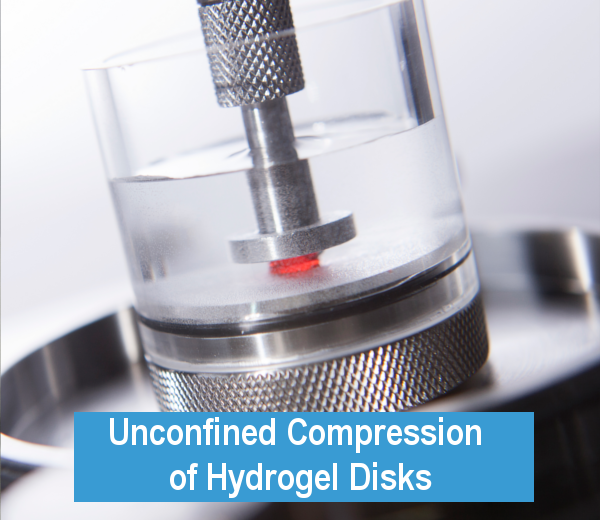
In vitro loading was performed 2 days following disk isolation in uniaxial unconfined compression. Pairs of disks were transferred to a sterile dynamic compression chamber containing culture media, and subsequently mounted onto the tester in the incubator. Disks were subjected to different loading protocols depending on the desired effects : degradation or stimulation. The degradation loading protocol was 40 cycles of 250 um in amplitude with a speed of 100 um/s while the stimulation protocol was 10 ramp/release of 100 um amplitude during one hour per day for five consecutive days.
The high amplitude loading protocol with the Mach-1 inside a tissue incubator did not alter cell viability of the intact full-thickness cartilage/bone explants (green=live cells, red=dead cells). Peak stresses were shown to be between 2 to 4 MPa using the high amplitude loading protocol. 40 cycles of this compressive load induced an enhancement of degraded collagen in the loaded samples. A smaller compression amplitude for a longer duration was shown to stimulate collagen synthesis, demonstrating the potential need for mechanical stimuli to produce tissues in vitro.
The Mach-1 can be used to precisely apply mechanical stimulation to living tissues in standard tissue culture incubators. It is particularly well suited for tissue engineering applications where loading protocols can be refined to produced desired effects on tissue metabolism and growth.
Figures

Figure 1 — Show caption
Fluorescence images comparing cell viability in mechanically loaded and unloaded cartilage.

Figure 2 — Show caption
Stress and displacement recorded during the first and fortieth cycles of the loading protocol.

Figure 3 — Show caption
Denatured type II collagen measurements in control and loaded cartilage discs.

Figure 4 — Show caption
CPII measurements in cartilage regions and culture medium from stimulated and control explants.
Products (1)
Accessories (9)


Test configurations (4)

Test configuration
Unconfined Compression

Test configuration
Impact

Test configuration
Confined Compression

Test configuration
Mechanical Stimulation (Compressive)
Materials (2)

Material
Articular Cartilage

Material