Cohesive Strength in PRP Hydrated Bone Grafts
Assessment of Cohesive Strength in Platelet-Rich Plasma (PRP) Hydrated Bone Grafts Through Unconfined Compression Testing
Introduction
Bone allografts play a crucial role in orthopedic and dental surgeries, providing a scaffold for tissue formation and promoting bone healing. The mechanical properties of the graft, influenced by its composition, are essential factors in graft design. Platelet-rich plasma (PRP) is sometimes used as the liquid phase of bone grafts due to its known regenerative properties [1]. In this study, we developed an in vitro platform to investigate the mechanical properties of cylindrical grafts formed by compacting PRP/corticocancellous bone mixtures using unconfined compression.
Method
Sample Preparation
Freeze-dried human corticocancellous bone chip powder (particle size: 500 µm to 1000 µm) was obtained from Vivex Biologics, FL, USA. Bone graft samples were prepared by hydrating 1.6 grams of bone chip powder with 360 µL of phosphate-buffered saline (PBS) solution for 5 minutes. The mixture was then homogenously mixed with 360 µL of ovine PRP obtained through serial centrifugation. To initiate PRP coagulation, 38.4 µL of CaCl2 was added to the mixture.
Molding and Compaction
A custom-made impaction system, consisting of a cylindrical mold with an 11 mm internal diameter and a cylinder piston, was used for molding the bone graft samples (Figure 1). The bone graft mixture was carefully added to the mold using a spatula to minimize material loss. The piston was then positioned over the mixture, and a 1.5 kg fixed weight was dropped on the piston 20 times from a height of 40 mm. After compaction, each sample was left inside the cylindrical mold for 6 minutes before extraction. The extracted bone graft cylinders were placed in the Mach-1 testing chamber for further evaluation.
Unconfined Compression
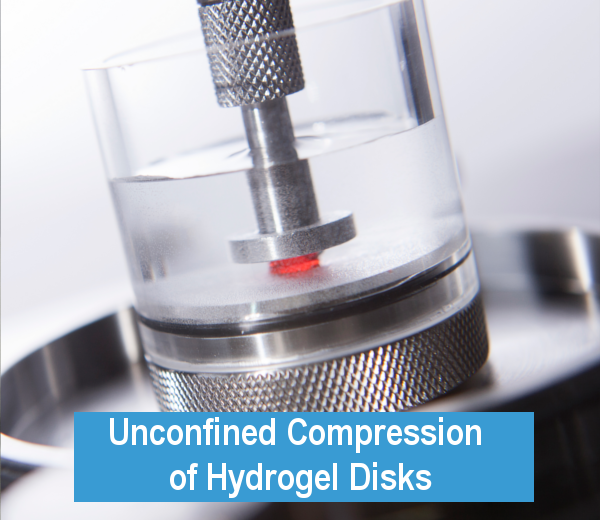
To evaluate the cohesive strength of the bone grafts, an unconfined compression test was conducted. The test procedure was based on ASTM-D2166: Standard Test Method for Unconfined Compressive Strength of Cohesive Soil [2], with slight modifications tailored for biological samples. The Mach-1 system v500c equipped with a 100N single-axis load cell was utilized for this case study.
The test began with a pre-compression stage, where a 0.5% axial strain was applied to the specimen's height at a rate of 1% per minute. This was followed by a relaxation period of 60 seconds to allow for stress redistribution within the sample.
Subsequently, the specimen underwent compression, with a deformation of 15% of its original height applied at a rate of 1% per minute. The cohesive strength was determined as half the compressive strength at 15.5% strain or failure [3]. Additionally, the mechanical data analysis provided information on other important parameters such as Young's Modulus (E), ultimate compression strength and cohesive strength.
Results
The mechanical testing of the bone graft samples yielded the following average values: Young's modulus of 1330 ± 213 kPa, ultimate compression strength of 99 ± 18 kPa, and cohesive strength of 49.3 ± 8.9 kPa. A comprehensive dataset with individual sample measurements can be found in Table 1.
During the compression testing, fissure formation and sample bulging were observed in response to the deformation of the allografts under mechanical stress. Additionally, there was no apparent expulsion of PRP from the bone grafts, indicating a suitable ratio and mixing of the bone grafts components. Figure 2 provides an illustrative example of these observations.
Discussion
The study demonstrated the feasibility of compacting PRP/bone grafts and assessing their cohesive strength using the Mach-1 mechanical tester with a 100N single-axis load cell. Unconfined compression testing of cylindrical bone graft samples, with an average height-to-diameter ratio of 1.70 ± 0.08, revealed an average cohesive strength of 49.3 ± 8.9 kPa. These results align with previous literature reporting cohesive strength values of 27.2 kPa for blood/fresh-frozen bone grafts subjected to unconfined compression [3]. The variation in cohesive strength can be attributed to differences in sample size and composition. In this study, the grafts consisted of PRP and rehydrated dry-frozen bone chips, with a diameter of 11 mm, while the referenced paper employed blood and fresh-frozen bone grafts with a diameter of 16 mm.
Shear testing represents an alternative method for assessing the cohesive strength of bone graft samples. Specifically, a test configuration that combines normal and shear loading would allow for the measurement of mechanical properties in particulate materials [4][5]. By utilizing another configuration of the Mach-1 system, the v500cs and a multi-axial load cell, both normal force and shear force can be simultaneously measured. Subsequently, normal stress and shear (cohesive) strength can be calculated, enabling exploration of the relationship between these variables through regression analysis.
Conclusion
In conclusion, this study successfully examined the cohesive strength of bone grafts hydrated with PRP through unconfined compression testing using the Mach-1 mechanical tester. The results demonstrated the feasibility of compacting PRP/bone grafts and assessing their mechanical properties. The average cohesive strength of the grafts was found to be 49.3 ± 8.9 kPa, indicating their ability to maintain structural integrity under compressive forces.
Moreover, the study highlighted the versatility of the Mach-1 mechanical tester in evaluating the mechanical properties of biomaterials, particularly in the field of bone tissue engineering. Unconfined compression testing proved to be an effective method for assessing cohesive strength, providing valuable insights for graft optimization and future research. The chosen methodology, adapted from soil testing standards, enabled the characterization of these biological samples and facilitated a better understanding of their performance.
Overall, this investigation provides valuable information for researchers and clinicians involved in the development and utilization of bone grafts. The knowledge gained from studying the mechanical properties of PRP/bone grafts contributes to the advancement of tissue engineering and may ultimately lead to improved surgical outcomes and the development of innovative therapeutic approaches in orthopedics and dentistry.
Authors: Rodrigue Caron1, Colleen Mathieu1, Sotcheadt Sim1, Martin Garon1
1. Biomomentum Inc.
References:
[1] J. Alsousou, A. Ali, K. Willett & P. Harrison (2013) The role of platelet-rich plasma in tissue regeneration, Platelets, 24:3, 173-182, DOI: 10.3109/09537104.2012.684730
[2] ASTM D2166-00.Standard test method for unconfined compressive strength ofcohesive soil.American Society for Testing and Materials 2000.
[3] Factors affecting the cohesion of impaction bone graft. The Journal of Bone and Joint Surgery. British volume 2006 88-B:6, 828-831
[4] Dunlop, D. G., Brewster, N. T., Madabhushi, S. G., Usmani, A. S., Pankaj, P., & Howie, C. R. (2003). Techniques to improve the shear strength of impacted bone graft: the effect of particle size and washing of the graft. JBJS, 85(4), 639-646.
[5] Dunlop, D. G., Brewster, N. T., Madabhushi, S. G., Usmani, A. S., Pankaj, P., & Howie, C. R. (2003). Techniques to improve the shear strength of impacted bone graft: the effect of particle size and washing of the graft. JBJS, 85(4), 639-646.
Figures

Figure 1 — Show caption
Impaction apparatus used to prepare cylindrical bone graft specimens.

Figure 2 — Show caption
Summary of specimen dimensions and mechanical properties measured in unconfined compression of bone grafts.

Figure 3 — Show caption
Bone graft specimen before compression, during loading and at failure.
Related resources (1)
Accessories (7)


Test configurations (1)

Test configuration
Unconfined Compression
Materials (1)

Material